Showing posts with label Bird Migration. Show all posts

Saturday, December 27, 2025

Borka: the adventures of a Goose with no feathers by John Burningham


Little Borka is born without feathers. Her mother knits her a woollen jersey (jumper or sweater) but of course this useless for flying and hopeless for swimming. I love the names of his siblings: Freda; Archie; Jennifer; Oswald; and Timothy.


Then, as you might have anticipated, the geese all fly away migrating to a warmer climate and poor young Borka is left behind. Luckily, he is befriended by a ship's dog and at the end of a long voyage he finds himself in London, in Kew Gardens. I love the final sentence:

"So if you are in Kew Gardens and you see a goose who looks somehow different from the others - it might well be Borka." and when I read this book to groups of young children I would add - why not go up and say hello!


I spied this book at a recent charity book sale for just $1 and considering this book was published in 1963 (paperback edition 1992) it is in a fabulous condition.

The best book to pair with Borka is of course the fairy tale The Ugly Duckling. 

I read somewhere that the art of John Burningham can be divided into several categories. Borka is from his first period along with books like these:


Later John Burningham produced books like Simp, Oi, Get off our Train, Would you rather?, Courtney, Mr Gumpy's Outing, Come away from the Water Shirley, Where's Julius, Avocado Baby, and Harvey Slumfenburger's Christmas Present.


This is my favourite John Burningham book. Simp was originally titled Cannonball Simp and decades ago I found an amazing almost silent movie (not an animation) of Simp which was captivating. 


My own first encounter with the art of John Burningham was in the book Chitty Chitty Bang Bang.


Sunday, December 7, 2025

Moonshadow by Gillian Lobel illustrated by Karin Littlewood

"All through the night they flew, pale shadows in the moonlight, 
over the cold brown land, through the stinging snowflakes, on, on never stopping."

It is time for the swans to fly south. This will be the first journey for young Moonshadow but he has the guidance and reassurance of his wonderful grandfather. 

The language in this book is lyrical - sunrise washed their feathers with gold and rose; they came to the wrinkled sea; lightning ripped the clouds; and white wings feathered the wind.

Moonshadow was published in 2009 so sadly it is now out of print but you might be lucky and find a copy in a library. In other places this book has a different title - Moonshadow's Journey. After you read Moonshadow you will want to hunt out more books illustrated by Karin Littlewood.


Here are the full plot details by Little Parachutes:

Moonshadow is a young swan about to set off on his first migration. He is nervous, but his grandfather reassures him along the way. His grandfather is the head of the swan family and leads the swans in their journey, which involves flying over many lands and seas. On the journey, Moonshadow struggles and his grandfather, knowing this, guides them down to rest whilst watching over them. On the journey there is a terrible storm. Moonshadow starts to fall but is helped by his mother and father. When the winds die down, Moonshadow cannot find his grandfather and is told of his loss in the storm by his mother. Moonshadow grieves for his grandfather and his father takes over as head of the swan family. His father explains to him that even though he is gone, his grandfather will always be in his heart and one day Moonshadow will grow up to lead the swan family too, as his father does now.

With a group of older students, you could compare this book with another title for younger readers:


Saturday, November 22, 2025

The Last Egg by Sofie Laguna illustrated by Jess Racklyeft


A mother bird is sitting on her nest. She has three eggs. The father bird is very attentive bringing her fresh worms to eat but then one morning; after hearing distant screeching in the night; the parents wake up to find a fourth egg in their next. The mother bird insists it's okay and that they have a responsibility to hatch this egg too. The problem is the first three eggs hatch on time, the baby chicks are just like the parents, and over time these three grow up and fly away. Meanwhile the fourth egg has not hatched. Should the birds abandon this egg? It is most certainly time they flew away to a warmer climate. In fact the snow is now falling and both are desperately cold.

The plot here will feel familiar, you might think of The Ugly Duckling with a twist - a dragon! The art in this new picture book is very appealing. And when you reach the end of the story, your young reading companion is sure to want to go back to the beginning to find that all important story hint (foreshadowing). 


Companion texts:


This one is very old - I hope you can find it - Fey Mouse by Hazel Edwards


And for an art comparison try to find this one:


I talked about the illustrator Jess Racklyeft recently. She has donated this original bird illustration for our IBBY Australia Mini Masterpiece art auction (14th - 28th November 2025).


Jess Racklyeft creates a variety of illustrated things - picture books, paintings, prints, pins and cards - mainly in watercolours. She works from her studio at the beautiful Abbotsford Convent and regularly has picnic lunches watching the neighbouring sheep and horses! Her art often combines collage - either on paper or digitally assembled - experimentation and lots of watercolour. Sometimes she writes the books as well. Jess worked in publishing sales for almost a decade before making the leap to full-time illustration and writing, and since then has won several illustration accolades including CBCA Picture Book of the Year for Iceberg (written by Claire Saxby).

Sofie Laguna is the author of many books including Too Loud Lilly; When You're Older; Our Australian Girl: The Grace stories; The Song of Lewis Carmichael; Stephen's Music; Bird and Sugar Boy; and an Aussie Bite title - The forever house. 

Wednesday, November 12, 2025

Super Swifts by Justin Anderson illustrated by Clover Robin


Subtitle: The small bird with amazing powers


Super Swifts is set in Africa, Europe and the UK BUT we do have swifts here in Australia - ork-tailed Swift (Apus pacificus); House Swift (Apus affinis); White-throated Needletail (Hirundapus caudacutus) and the Uniform Swiftlet (Aerodramus vanikorensis). One of our Australian netball teams is named The Swifts!

I find the topic of bird migration endlessly fascinating. Click the label on this post to find more books on this topic - try to find Circle by Australian illustrator Jeannie Baker. 

Swifts are a family of highly aerial birds known as Apodidae, which reside within the Apodiformes order alongside hummingbirds. ... Swifts have small, weak legs, which led to them sometimes being depicted without feet historically. ...  There are about 100 species of swifts, which are known for their high speeds, with the white-throated needletail reaching up to 169 km/h. They have elongated wingtip bones and the ability to rotate their wings from the base, which aids in their maneuverability and efficiency in flight. Swiftlets have evolved a form of echolocation to navigate dark caves. These birds are found worldwide except in the extremes of the polar, desert, and some oceanic islands, and migratory swifts travel from temperate regions to the tropics in winter. Their nests, often attached to vertical surfaces with saliva or located in wall cavities, are unique—some are used in the traditional bird's nest soup. Swifts are insectivores, hunting mid-flight, and their breeding and development patterns are more similar to seabirds than passerines. While no swift species has been recorded as extinct since 1600, some are considered endangered or vulnerable ... (Source)

All about swifts:
  • Coloured dark, sooty brown but can look black against the sky 
  • Pale patch on the throat, but this is often difficult to see in flight 
  • Long, pointed wings held in a ‘boomerang’ shape 
  • Wings are narrower than those of a Swallow or martin 
  • Short, forked tail which can be folded to a point 
  • Bullet-shaped head 
  • You’ll often hear them before you see them – they make an unmistakable, high-pitched ‘scream’ 
  • Swifts can travel up to 500 miles in one day
  • They 'sleep' while flying - this is called unihemispheric slow-wave sleep, where one half of their brain remains alert while the other half enters a sleep state.
  • Swift fly slowly through rain as a way to keep clean
  • Swift mate for life
  • They can catch as many as 50,000 insects in a day
  • They can live up to 21 years
Here is a map showing the journey of one swift in 2010 and you could show this video to your students:


Image source: Turning the Stones

The first thing I noticed in the two books I read today about swifts (see below for the second title) is their large eyes. So, I went hunting for a photo of a swift.


Images source: Audubon Society

I also thought about collective nouns which is a topic I find quite fascinating. What do you call a group of swifts? I found four possibilities Flight, Scream, Flock or Kettle!

Then I found this one - a sweep of swifts:

Swifts are highly agile and acrobatic birds known for their remarkable speed and graceful movements in the sky. When witnessed together, their collective presence forms a breathtaking spectacle as they swoop, loop, and glide through the air, displaying remarkable synchronization and coordination. The term sweep embodies the seamless and synchronized movements performed by these swifts, as if they are brushing through the atmosphere with remarkable elegance. The sight of a Sweep of Swifts evokes a sense of awe and wonder, as these social birds create a hypnotizing performance while efficiently navigating their surroundings.


Publisher blurbA swift may not look like anything special—it’s just a plain brown bird, small enough to nestle in the palm of your hand—but these superheroes of the avian world can fly incredible distances amazingly quickly, reaching speeds of up to seventy miles per hour and spending ten months of every year in the air. Follow one female swift from the steamy forests of tropical central Africa to northern Europe as she navigates arid desert and restless ocean, dodging predators along the way. Eating, drinking, and sleeping on the wind, she won’t rest until she’s reached her nesting site. Woven through with fascinating facts amplified in an author’s note and index, Super Swifts fuses gorgeous collage illustrations and a lilting text to evoke the grandeur of a voyage like no other—and introduce a singular bird with amazing powers.

Text in a larger font provides a smooth narrative, ideal for a read-aloud, while text in a smaller font offers intriguing facts. A series of text boxes describe the swifts’ symbiotic relationship with the louse flies that ride north in their feathers, lay eggs in swift nests, and send a new generation of swift lice south in the fall. Robin’s mixed-media illustrations show the changing scenery in double-page spreads; smaller vignettes depict nesting details and a thrilling scene in which our protagonist must evade an attacking falcon. Kirkus

Super Swifts is published by Walker Books. I need to explain this series (and my confusion). When Walker Books started this series, where a narrative is paired with facts presented on the same page in a smaller font,  they were called Read and Wonder. To me this was the perfect series name. Then many years later the name changed to Nature Storybooks. Same format, same fabulous topics and most importantly same highly skilled illustrators. Fast forward to today - Walker Books are still producing these wonderful books which need to be added to EVERY school and public library BUT now there is no series name.  I can only ask why?

Companion book (you need this one in your library too):


I am a huge fan of collage art by Clover Robin - here is her instagram page. Here are some two books I have talked about here she has illustrated:


Other Read and Wonder or Nature Storybook titles:


Saturday, October 11, 2025

The Other Ducks by Ellen Yeomans illustrated by Chris Sheban


"Two is not a line. Two is a follow. A line is more ducky."

Blurb: This Duck and That Duck are inseparable, but they long for more friends to waddle with. When they discover The Other Ducks beneath the water, their excitement turns to frustration as these new companions refuse to leave the pond. With winter approaching and their feathers itching for warmth, will This Duck and That Duck find a way to bring The Other Ducks into their world? Dive into this charming tale of friendship and discovery as these ducks navigate the challenges of expanding their circle.

The two ducks in this story, male and female, are so naive about the world (something your young reading companion will both relate to and laugh over). They are only two but they want to form a line so they need more ducks. In the pond/puddle of water they discover two more companions but very strangely on cloudy days these two others disappear and for some reason they won't follow This Duck and That Duck out of the pond. Then suddenly they discover they can fly and in the sky they do find other ducks - but where are they going and why?  The final page of this book will give you the biggest smile. 

This Duck (a confident female) and That Duck (a trepidatious male) enjoy each other’s companionship in the “wadey-water” until discovering a wider world makes the extrovert wish for more friends.This Duck yearns to lead a “more ducky” line when they move about, prompting her to wish for Other Ducks. Yeomans’ language is a delightful combination of the childlike and the existential. When questioned about the meaning of “Other Ducks,” she replies, “Like us, only not us.” Sheban’s soft, textured compositions are rendered in watercolor, colored pencil, and graphite; they start out sunny, with warm greens and yellows in the foreground and cool lavender shadows and shapes on the horizon. The lighting and mood change with the seasons and situations. ... A marvelous portrayal of the humor and uncertainty surrounding growth—and the comfort in having a fellow traveler. Kirkus Star review

This book was published in 2018 so it is now out of print BUT if you can find a copy in a library (as I did) you should grab it with both hands and settle down to read this with your young reading companion or borrow it to share with your preschool group. I live near a lake/lagoon with plenty of ducks - it would be so brilliant to read this book during or after your visit to see my ducks. 

Reading a wonderful picture book with a young child is such a meaningful way to discover rich words. In this book we have rushes, lush, wadey-water, waddle, splashed and splished, fretted, and this wonderful final sentence:

"And every single one of them felt downright ducky."

Chris Sheban is the illustrator of these two books below. I would like to see Three Squeezes, Someone like me (Patricia MacLachlan) and Job Wanted. He also illustrated What to do with a box which I will borrow next term from my friend's school library AND I now discover he did the covers of Because of Winn Dixie, Tiger Rising and Paperboy. See more here.


Thursday, May 15, 2025

Gozzle by Julia Donaldson illustrated by Sara Ogilvie


Bear wakes up from his hibernation. He sees an egg. He could eat this for breakfast, but then he hears it tapping and, quite suddenly, out pops a baby goose - a gosling. The bear is the first face she sees so of course she thinks this bear is her daddy. Young Goozle is "programmed" to follow and imitate the first face she sees which would usually be her own parents. To the young goose it seems obvious that Bear is her daddy. Bear is not happy but underneath his gruff exterior there are hints of his kindness and as the seasons progress it is also clear this pair are forming a strong bond. But then comes the day little Goozle is old enough to fly and then old enough to fly with her flock - it is time for the geese to migrate to a warmer place. Like all good parents, Bear worries about his young charge. Can she swim? Can she fly? Will she be safe when she flies away? And most important of all - will Bear ever see her again? Bear heads back to his cave to hibernate through the winter. Then spring arrives and so does ...

Julia Donaldson had been thinking about animal imprinting. Here is a list of animals that use this process to assist their young: geese, ducks, zebras, raccoons, guinea pigs, chickens, hyenas, and the turkey.

Here is a three minute video Q&A where Julia Donaldson talks about Gozzle. I'm sure you are very familiar with lots of Julia Donaldson picture books. My own favourites are: Follow the Swallow, The Magic Paintbrush, Tiddler, Who lives here?, Room on the Broom, and The Snail and the Whale. I have a plan to read Paper Dolls next - I gifted this to a friend for her granddaughter and then another friend mentioned it was a huge hit with her own four young children. 

I am sure you have your own Julia Donaldson book collection either at home or in your school library. Goozle is another sweet story by this master storyteller which is sure to charm young children and adults alike. The happy ending certainly made me smile.

Bookseller blurb: It's springtime. Bear has woken up hungry and finds a lost egg outside his cave. Breakfast? No! Out hatches Gozzle, a very sweet little gosling who is convinced that Bear must be her daddy – and that she should be able to climb, dig and eat honey just like him.

Sara Ogilvie was born in Edinburgh and now lives in Newcastle. She graduated with an Illustration/Printmaking degree from Edinburgh College of Art. Sarah has won numerous awards for her work including a Commonwealth Heads of Government commission, presented to Nelson Mandela and HRH Queen Elizabeth II. Her work is inspired by words, street life, antiquities, posters, old wives tales, household appliances, carpets, masks, trying to spell sounds, packaging and old second-hand bookshops… Nosy Crow  

She is the illustrator of many books including Dogs Don't Do Ballet, Do Not Enter the Monster Zoo, Once Upon a Wish and Julia Donaldson's Detective Dog.


If you are thinking of your library program it would be terrific to explore some Julia Donaldson books with your young groups and then, even better, use these as a jumping off point to explore all the different illustrators whose work is showcased via her huge body of work. I would explore illustrators such as Helen Oxenbury; Charlotte Voake; Yuval Zommer; Emily Gravett; Catherine Rayner; Sharon King-Chai; Rebecca Cobb; and of course Axel Scheffler. 

Thursday, February 20, 2025

Lotus and Feather by Ji-Li Jiang illustrated by Julie Downing


Lotus has been unwell, and her illness has taken her voice away. The other children no longer invite her to play. She lives with her kind, wise and compassionate grandfather beside a lake that used to be filled with lotus flowers, birds and fish. 

"One morning, Lotus went to collect reeds for her Grandpa. She stopped in awe when she saw a big bird, as white as fresh snow, standing in the marsh grass. Its wide wings edged with black feathers, like lace on a dress. Above the long, curved neck, its head was crowned with a red top like a dazzling ruby."

As Lotus stands looking at this exquisite creature a gunshot startles her. Her bird has been shot. She carefully carries him back to her grandfather. Over the coming weeks and months Feather gradually heals and eventually he stands up and even seems to dance. This entrances the other children. Then one evening Feather begins to crow loudly. He has sensed an earthquake. Lotus and her grandfather rush to alert the villagers because their lake is about to flood. 

Bookseller blurb: A winter illness left Lotus, a little girl, without a voice and without friends. A hunter's bullet left Feather, a crane, injured and unable to fly. As Lotus nurses Feather back to health, their bond grows. Soon Feather is following Lotus everywhere, even to school! The bird dances to the girl's reed whistle, much to the delight of the other children. One day, when the village floods, Feather helps raise the alarm as Lotus and her grandfather urge their neighbors to get to high ground. Feather is a true friend to Lotus, but the time comes when Lotus must be a true friend to him--by encouraging him to migrate with the rest of the cranes. The next spring, Feather miraculously returns, and that's not all . . . he has brought new life to the nearby lake. Inspired by the true story of a crane that rescued a Chinese village, and graced with sensitive watercolor illustrations, this lovely book about respecting nature offers deep emotion and delightful surprises.


Elegant storytelling and arresting compositions combine for a deeply satisfying emotional and aesthetic experience. Best shared one-on-one or in a small group so that children can pore over the lively and engaging artwork. School Library Journal

Downing’s finely crafted illustrations perfectly complement this reassuring story. Done with watercolor, pencil, and paint and digitally collated, they have the look of Chinese paintings, with misty backgrounds and gently bending reeds. The rosy-cheeked children wear red scarves, alluding to the author’s own childhood during the Cultural Revolution. Kirkus

My friend at Kinderbookswitheverything set up an extensive display of books for Chinese New Year and among them I found Lotus and Feather. This is a book to read and treasure and it has wonderful illustrations. It was published in 2017 but I think it is still available although sadly, as with all US Picture books now, it is very expensive at over AUS$40. I have not found a paperback edition. 

Here is the webpage of the illustrator Julie Downing. Read more about Ji-Li Jiang here. You can watch a video of the book at Storyline Online

Friday, June 28, 2024

Feathers Together by Caron Levis and Charles Santoso


Storks Klepetan and Malena plan their migration every year leaving behind the cold winter in Europe and spending summer in South Africa. They make this huge journey year after year

"But then Malena got hurt. ... After much resting and healing Malena's wing did not hurt but it wouldn't flap, so she couldn't fly up to their nest."

Luckily a kind local man saw this dilemma and so he constructed a series of ramps to assist Malena. But what will happen when Winter arrives. Sadly, Klepetan has to leave without his mate.   

"... missing each other was like having an itch in a place neither could reach to scratch. Missing made new food taste icky and old foods taste blah. It made sleeping too loud and waking up too quiet."

Spoiler alert - our beautiful pair of storks are reunited.


"This book is inspired by the true story of Malena and Klepetan; two white storks who spent a season of each year living over eight thousand miles apart. They reunited every spring for nineteen years in the village of Brodski Varos, Croatia, until Malena died of old age in 2021. The pair birthed and raised sixty-six fledglings with the support of their human caretaker, Stjepan Vokic (a school caretaker)."

The Australian distributor for this book is Thames and Hudson. It is priced just under AUS$30. Hopefully there will be a paperback edition because purchasing this book might be beyond most school library budgets. 

  • Storks are large, long-legged, long-necked wading birds with long, stout bills.
  • They live on all continents except Antarctica and are most common in tropical regions.
  • Many species prefer to be in or near wetlands, though some occur in drier areas.
  • There are 19 species of stork.
  • Storks have remarkable eyesight, allowing them to spot small prey from great distances.
  • They use their keen vision to locate fish, amphibians, reptiles, and insects, which make up a significant portion of their diet.
  • Storks are highly social birds and are often seen in large flocks, especially during migration.
  • Storks belong to the family called Ciconiidae and make up the order Ciconiiformes.
  • The lifespan of storks is about 30 years and sometimes up to 40 years.

Migration: The average journey south takes 49 days and almost 20,000 km. This stork species sets out from Europe and moves over the Strait of Gibraltar into the Sahara desert, following the heavy thermal systems that allow it to efficiently soar to its destination (and even conserve energy in the process!). These flocks, some with almost 11,000 individuals, then follow the Nile River south to eventually settle in various African countries, including Kenya, Sudan, and South Africa.

Storks are classified into these six categories - the storks from this story are Ciconia Ciconia.
  • Genus Mycteria: Known for the Painted Stork and the familiar White Stork.
  • Genus Anastomus: Home to the Openbill Storks.
  • Genus Ciconia: Includes the Woolly-necked Stork and the Black Stork.
  • Genus Ephippiorhynchus: The Saddle-billed Stork falls under this category.
  • Genus Jabiru: The Jabiru is the only member, native to the Americas.
  • Genus Leptoptilos: Notable for the massive Marabou Stork and the Lesser Adjutant.

The author draws out the tension in the most delicious way, readers rushing to the end so that the birds can be reunited, and likely there will be no dry eyes in the house when the duo are finally once again nestled next to one another, feathers together. The digital illustrations give marvelous personality to each stork, their every emotion evident and so relatable for readers. Kirkus Star review

Here is a 16 minute video where you can see Caron Levis and Charles Santoso. Look for these other books by Caron Levis:


Check out this interview with Charles Santoso and Caron Levis. Charles Santoso (he lives in Singapore) is the illustrator of Happy Hippo (2021), Feeling Grateful by Kobi Yamada (2022), Wombat Underground: A Wildfire Survival Story by Sarah L. Thomson (2022), Finding Muchness by Kobi Yamada (2021), The Bookstore Cat by Cylin Busby (2020),  Dandy by Ame Dyckman (2019), Watch Out for Wolf! by Anica Mrose Rissi (2019), Peanut Butter & Santa Claus by Joe McGee (2019), Dragons Get Colds Too by Rebecca Roan (2019), Penguin & Tiny Shrimp Don’t Do Bedtime by Cate Berry (2018), No Boring Stories! by Julie Falatko (2018), The Snurtch by Sean Ferrell (2016), Peanut Butter & Aliens by Joe McGee (2017), I Don’t Like Koala by Sean Ferrell (2015), Peanut Butter & Brains by Joe McGee (2015). He’s also illustrated a number of middle grade novels, including Odder by Katherine Applegate, (2022) Willodeen by Katherine Applegate (2021), A Boy Called Bat series by Elana K Arnold (2018), and Wishtree by Katherine Applegate (2017) - a New York Times bestseller.

Their latest collaboration is this one - Mighty Muddy us:


Tuesday, December 27, 2022

A Swallow in Winter - A Christmas Miracle by Timothée de Fombelle illustrated by Thomas Campi


"Sitting in his van for hours, he would brood over the great unrest of our times, how everything had gone to rack and ruin, invaded, unrecognisable."

"This call, Gloria sensed, was intended for her alone and for her freedom. Somebody was waiting for her, up north."

"Gloria was determined to understand everything. Sorrow, loves, wars, even children's games. During her long voyages in springtime and at the summer's end, Gloria roamed battlefields and burnt-out residential blocks. She followed wedding processions and families taking to the road in search of peace."

Every so often I read a book that just makes me sigh with happiness and marvel at the power and wonder of storytelling. With a book like this one - A Swallow in Winter - I want to rush out and buy a handful of copies to keep in my bag - why? Because I would love to thrust this book (and others such as Wishtree by Katherine Applegate and Captain Rosalie also by Timothee de Fombelle) into the hands of adults who challenge my love of children's books, who scoff at my passion for reading, almost exclusively, books written for children. At nearly every social occasion, especially over Christmas, I endure this kind of censure and I guess you can tell it annoys me.

I have listed this book as a French picture book but really it is a novella. It is a small, almost hand-sized volume with full colour and full page rich illustrations. A Swallow in Winter was written in 2019 in French and translated by Sarah Ardizzone into English in 2022. The French title is Quelqu'un m'attend derrière la neige. Take a look here to see inside this book


There are three narrative threads in this story. The swallow from the title has decided not to follow her instinct to fly south and instead she has headed to the North on this cold snowy winter night. Her decision has come following an accident many years ago where she crashed into the coloured window of a church. Later we discover her name is Gloria.

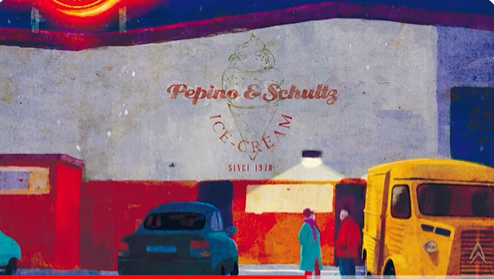
The second narrative thread is where we meet a man who drives an ice cream van. Freddy d'Angelo has worked for the gelato company - Pepino & schultz for thirty-seven years. It is Christmas Eve and he is driving from Genoa to London. His van contains six hundred tubs in two flavours - almond milk and chestnut. 


"Freddy had been counting. It would soon be a hundred days since anybody had spoken to him properly."

So we have a tiny bird flying through the cold night. We have a lonely man in his truck who has never even tasted the ice cream he delivers. But what of the third narrative thread? Sorry dear reader but I am not going to share this with you. I will only say the ending of this story is sure to surprise, delight and shock you. At the end of this small volume Timothee de Fombelle will take you to an extraordinary story destination. 


Thomas Campi is an Italian illustrator. One critic said "Delicately put into images by the Italian cartoonist Thomas Campi, who produces almost every two pages of superb illustrations in warm and rich colours, this text proves to be as unclassifiable as its heroes."

This might be a spoiler but take a close look at this illustration:


In this short French video, Timothee de Fombelle reads from his book - and you can hear a soft sound track of Frank Sinatra which Freddy, the truck driver, plays on his old cassette player all year round.

When the three destinies meet, it seems their search for hope, belonging and kindness has finally ended. An atmospheric and heart-warming story, perfect for this very special time of year. Reading Zone