Showing posts with label Crickets. Show all posts

Saturday, June 20, 2026

102 by Mathew Cordell


This is the image under the dust jacket!

The endpapers in 102 are intriguing. They are filled with 102 beans but while you will recognise some as real beans such as borlotti bean, pinto bean, lima bean and fava bean. Others are quirky such as morning bean, owl bean, Frisby bean, Lobel bean, Poppy bean, Cornbread bean, Sendak bean, and Steig bean. There is even a coffee bean!


The number 102 is the title of this book but it is so much more. The boy's temperature rises to 102; at 1.02am he wakes up and follows the cricket into a different world; the ant has 102 babies; and George's destination is 102 Acorn Hollow and there is a surprise on the last page which refers to 102 again. AND you need to look closely at many pages to find more references to 102 in the illustrations on labels, on a rug pattern, on George's wall and so on.

Watch the way Matthew Cordell creates his illustrations for this book using a multicoloured, multiscented ballpoint pen. "He liked it so much, he went on to draw 102 with it, layering many lines of one colour over another. It took sixteen of these pens to draw all forty-eight pages of this book."


In this podcast Matthew talks in detail about 102 and the inspiration and creative process.

It's time again for more process talk about my new picture book, 102. One of the earliest points of origin for the story, that I can remember, happened way back in 2019. While working in my basement studio, I noticed one afternoon that a frog had gotten trapped in one of our window wells. Rather than save it myself (or, frankly, let it die in there). I waited for my then 1st grade son, Dean, to get home from school and we could figure it out together. He suggested we lower a bucket down and we'd pull it up and out. It took a bit of encouragement (I had to broom the frog into the bucket), but ultimately, we were able to save our new wee green friend that day, father and son! That little blip in our lives was all it took to spark the beginning of 102, which is, at its heart, an animal rescue story. In 102, a mouse is captured in the family kitchen, and young George hopes to keep it as a pet. Without spoiling too much, one outrageous thing happens after another where George shrinks down to the size of a mouse and begins a nighttime adventure, where he learns about the life of that mouse he's captured. This convinces him that it's only right that he release the mouse to get back to his own life and family. It took years for that beginning spark to unfold into the story that became 102, but sometimes that is how these things take shape. Matthew Cordell 

Publisher blurb: Sent home from school earlier in the day with a fever, George awakens in the middle of the night to discover a cricket beckoning him on an adventure and soon finds himself shrunken down in size. He follows the insect guide through a crack in his bedroom wall, through the moonlit yard, and into the home of a family of mice at the base of an oak tree. There, in a tiny, cozy kitchen, George discovers the meaning of his quest: he must help the Mama mouse complete her special 102-bean soup for her sick young son.

Here are some review comments:
"Tender and imaginative." —SLJ, starred review
"Graceful, cozy." —Booklist, starred review
"A weird and wonderful story." —Horn Book, starred review
"Pulses with warmth and inventiveness."—PW, starred review


The Kirkus Star reviewed likened 102 to The Borrowers. I also thought of A Cricket in Time Square.


I discovered Matthew Cordell from his Cornbread and Poppy series many years ago. I adore these little beginner chapter books. 


Sadly, not many of his picture books have made it to Australia. I am keen to read these two picture books below. I have also added images of the case reveal - we don't do many picture books here in Australia with dust jackets. A different image under the dust jacket adds something a little bit magical to a picture book. US illustrator Matthew Cordell often adds this extra surprise:


Matthew Cordell is the author and illustrator of many celebrated picture books for children, including the Caldecott Medal winner Wolf in the Snow, Evergreen, a Publishers Weekly Best Book of the Year, Hello Neighbor!: The Kind and Caring World of Mr. Rogers, a Bank Street Best Children’s Book of the Year, and the Cornbread and Poppy series, which Booklist in a starred review has called “a rewarding choice for young readers.” Matthew lives outside of Chicago with his wife, author Julie Halpern, and their two children.


I have also previously talked about these:


Friday, December 5, 2025

In a Village by the Sea by Muon Van illustrated by April Chu


We talk about the magic that happens when you share a book with a child - thinking about the story and the possibilities of hearing rich lyrical language but the other really special part of a picture book can be the way it gives a child an experience of fabulous art and that is certainly the case with this book In a Village by the Sea. It would be wonderful to share this book with a group of children or as part of a library storytelling session and you could also share this book with an art class. You will want to talk about the famous painting: The Great Wave off Kanagawa.

I discovered this book in the library where I work as a volunteer because we were gathering books about 'mini beasts'. I was curious about why this book appeared on their curated list. I guess because it contains a cricket but this book is SO much more. I hope you can find this book but it was published in 2015 so you will need to hunt in a library. (note: one online seller here in Australia does list this book but it is over AUS$40). 

The way the text works is similar to A Dark Dark Tale by Ruth Brown and also Zoom by Istvan Banyai. 


Here is part of the text from In a Village by the Sea:

"In a fishing village by the sea there is a small house. In that house, high above the waves is a kitchen. In that kitchen is a bright glowing fire. In that fire is a pot of steaming noodle soup."

I would use the term cinematic to describe the way the illustrations in this book are presented - we start with a view of the village looking over the ocean from a small fishing boat. Come a little closer and you can see one house in the village with a dog looking in the window. 


Closer now we see the dog walking into the kitchen. Next page there is a steaming pot of noodles and then we see mother preparing the spices to flavour her soup. 


Closer still the baby is yawning in his basket by the fire. Now turn the page and the view completely changes - we are above the scene and can see the kitchen, the table and soup ingredients, the baby and his mother. But the dog has heard a noise under the floorboards so we zoom down again to a close view of the dog's nose and a cricket with several paint brushes - his image almost fills the page. What is he painting? And how does this relate to the mother, her child and their father who is fishing out at sea?


Awards:
★ Northern California Book Awards Children’s Literature, Younger Readers Winner
★ Huffington Post Best Picture Books Best Surprise Winner
★ New York Public Library’s 100 Notable Titles for Reading and Sharing Selection
★ New York Public Library Best Books for Kids Selection
★ Junior Library Guild Selection
★ Kirkus Reviews Best Picture Books Selection
★ Cybils Award Finalist
★ Kirkus Reviews Starred Review
★ Publishers Weekly Starred Review

Companion books:


Here are two other books by Muon Van:


Thursday, June 15, 2023

Maggie and the Pirate by Ezra Jack Keats


There is an important layer to this story that is quietly implied. Take a look at these text quotes:

"Maggie and her parents lived in an old bus which they had made into a home."

"It was the cage ... I wanted it real bad ... I didn't mean for the cricket to die. My ol'man - he never makes any things for me. He doesn't ever talk to me."

In the illustrations we can see a shanty town and the children are wearing mismatched clothing and they have bare feet. So as an adult reader we know poverty is implied. It is important for our children to see other kids living in very different circumstances even if they don't have any understanding of poverty as depicted in this book. 

Maggie loves her little cricket. He lives in a small cage made by her grandfather. 


When her mother asks Maggie to go to the grocery store she hangs the cage on a tree but when she returns the cage and her little cricket friend Niki are gone. On the tree there is a hand written note that says : "The pirate was here."  Maggie is determined to find this "pirate".  Perhaps the title of this book is a little misleading. The "pirate" is just another kid - a lonely, poor and perhaps mistreated kid - who likes the look of the that cage. When Maggie finally tracks him down there is an accident. The boy is perched in a makeshift tree house. It crashes to the ground and the little cricket is killed. 

"They buried Niki. Maggie wrote his name on a piece of wood and put it over the small grave. Paco picked some flowers and brought them over. Then they sang sad songs."

The boy appears and he explains why he took the cricket and the cage - he is deeply sorry. He takes the cage from Maggie and puts a new cricket inside. 

I love the quite words of the ending. Again so much is left unsaid:

"They all sat down together. Nobody said anything. They listened to the new cricket singing. Crickets all around joined in."

Look at the power words here - together, they listened, joined - the promise of new friends!

I mentioned a few days ago that the library I visit each week have filled a tub with books that have not been borrowed for a long time. One of these is Maggie and the Pirate by Ezra Jack Keats. The books in this school library are generally in almost mint condition but this book is quite worn out which is strange because it has not been borrowed since 2001 and in total it has only been borrowed 14 times beginning in 1985. 

I learnt a new word today reading the Kirkus review of Maggie and the Pirate: 

Unlike Keats' city slums, this palm-treed, riverside shantytown has a ramshackle insouciance.

insouciance means: free from concern, worry, or anxiety; carefree; nonchalant

Now comes the difficult decision for the library. Ezra Jack Keats is a very famous US illustrator and his collage illustrations are wonderful and still fresh all these years later. Unfortunately Maggie and the Pirate is now out of print. There are lots of other Ezra Jack Keats books still available so perhaps the library should be content with these but I do know the Teacher-Librarian likes to hold the "body of work" of significant authors and illustrators. Another issue is the confusion that this book is not really about pirates and perhaps the cover is not very appealing to a modern child even though I do like it. Oh and the topic of actual pirates is a fraught one because real pirates do exist and if your school has refugee children this is a topic you should either avoid or treat very sensitively. 

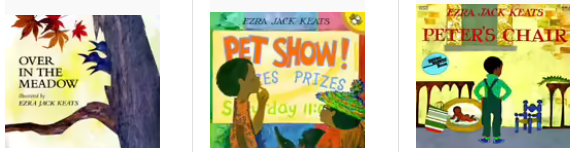
I have talked about two books by Ezra Jack Keats:


Here are other books by Ezra Jack Keats:


Thursday, January 14, 2010

The Cricket in Times Square by George Selden

Chester the Cricket, Tucker the mouse and Harry the cat are the most unlikely of friends but thank goodness they are friends because together they are able to help Mario and his family who own a small newsstand in Times Square.

If you enjoyed Tumtum and Nutmeg, The Tale of Despereaux and A Rats Tale then you will certainly love this classic book The Cricket in Times Square. Just like Tumtum and Nutmeg there are moments when I just gasped out loud for example on the night when the friend’s discover Chester has this amazing musical ability. Just when everything is going really well and it seems there might be a way to help Mario and his family who are so poor, Tucker topples over a box of matches. “One match, unluckily, struck right next to a pile of that mornings newspapers. The spurt of flames it sent up lit the frayed edge of the papers and quickly spread over the whole bundle.” This is particularly disastrous since this happens in a small newsstand filled with papers and magazine.

The Cricket in Times Square is once again a very old book. It received a Newbery honor in 1960 but I am very pleased to say that it certainly stands the test of time. I will hunt out a new copy for my school library and this is a book I will recommend to my middle primary readers and their teachers. In USA there was even an animated television show of this book in 1970s.