Showing posts with label Holocaust. Show all posts

Saturday, October 17, 2026

The Mozart Question by Michael Morpurgo illustrated by Michael Foreman


This is one of those very powerful shorter books that would be perfect for your reluctant readers in Grade 6 or 7. The reporter is told not to ask 'The Mozart Question'.  Why? Paulo decides to tell his story of survival during the holocaust. This is not a book for young readers. Concentration camps and gas chambers are mentioned. Make sure you take a close look at the cover.

Michael Foreman adds his usual fabulous water colour art to this book:


Sadly, this book from 2007 is out of print but I am sure it will be easy to find a in many libraries.

... it is Paulo himself who decides that the time has come for the truth to be told. And so follows the story of his parents in a concentration camp, forced to play Mozart violin concertos for the enemy; how they watched fellow Jews being led off to death and knew that as long as  they were played  they themselves would live. (read about the stage play of this book)

In this stunningly written and very moving book Michael Morpurgo pays tribute to the Jewish musicians who played musical instruments during their captivity in German concentration camps. Their skill kept them alive, and they played to survived. Morpurgo also explores the idea that secrets are often no better than lies. There comes a time when the truth must be told and only then can healing begin. Through the Looking Glass review

You can read background notes from Michael Morpurgo here. 

Publisher blurb: When Lesley is sent to Venice to interview world-renowned violinist Paulo Levi on his fiftieth birthday, she cannot believe her luck. She is told that she can ask him anything at all – except the Mozart question. But it is Paulo himself who decides that the time has come for the truth to be told. And so follows the story of his parents in a Jewish concentration camp, forced to play Mozart violin concerti for the enemy; how they watched fellow Jews being led off to their deaths and knew that they were playing for their lives. As the story unfolds, the journalist begins to understand the full horror of war – and how one group of musicians survived using the only weapon they had.

This book caught my eye at a recent charity book sale because I recognised the format. I previously read (and enjoyed) these books - the series doesn't seem to have an official name but they are published by Walker Books UK.


Saturday, March 7, 2026

The Year we Escaped by Suzanne Leal


I picked up this book (purchased from Gleebooks Kids) to read yesterday and finished it this morning. The Year we Escaped is one of the 2026 CBCA Younger Readers Notable titles.

This story explores a different aspect of the Holocaust and World War II where over six thousand five hundred Jewish people from the German regions of Baden and Saapflaz were transported to the Gurs Internment Camp in the Free Zone of France.

The author of this book Suzanne Leal heard about a small French village called Le Chambon-sur-Ligon. During the war some communities like these gave refuge to Jewish children. Suzanne stayed "at a guesthouse called Chez Tante Soly, where twenty-two Jewish children had been hosted and protected throughout the Second World War. ... What a story, I thought as my mind kept turning to the lives of these children caught up in that dangerous time. Where had they come from, I wondered, and how had they found their way to this remote village?"

This is the basis of The Year we Escaped which covers the period November 1938 to September 1941. We meet children from two different families. Klara lives in Germany and you will watch with horror as she experiences first hand the persecution of the Jews - smashing of her parents shop windows (Kristallnacht), horrible treatment by people in her town and then her dismay as she has to change schools. Her experiences reminded me of Dancing on the Bridge of Avignon by Ida Vos. Klara's mother decides they urgently need to leave but mother and daughter do not reach safety, instead they are taken to the Gurs Internment Camp. It is an utterly horrible place. The descriptions of the latrines will 'turn your stomach'. (There are extensive notes at the back of the book about Gurs and other aspects of WWII).

Meanwhile Lucien and his brother Paul live in Paris. Their father is a doctor but he is left behind when they are also forced to leave with their mother. By chance there are now four kids - Klara, her friend Rachel, Lucien and his younger brother Paul - in this camp. They quickly become friends. Klara works out a way to leave the camp and she and Lucien enjoy picking the blackberries (they are on the back cover of the book) but the kids don't appear to think about escape. Then suddenly Klara and Rachel are 'rescued' and taken by train to Le Chambon-sur-Ligon. Lucien and Paul's mother decides her boys need to find a way to get there too but for the boys it means sneaking out of the camp and embarking on a 750km train journey. This journey takes up the second half of the book - Suzanne Leal creates some terrific tension on their train journey and at every turn I kept anticipating that terrible things would happen to the young brothers. 

Leal blends fact, fiction and feeling so beautifully, crafting a story that’s deeply emotional and brilliantly paced. It’s historical fiction done right: full of heart, action and unforgettable characters. Readings Melbourne

Suzanne builds her story gradually detailing the changes brought about by a war that affects everybody’s life. She has obviously thoroughly researched Kurs as it is brought vividly to life. Klara and Lucien are passionate relatable characters, perfect advocates for peace, tolerance and acceptance, the dominant themes in this carefully structured novel. Story Links

You can read a chapter sample and find teachers notes on the publisher web page.

Awards: Winner 2025 ARA Historical Novel Prize – Children & Young Adult Category

As an adult reader you know that the people left behind in the Gurs camp will be taken to places like Auschwitz but younger readers aged 10+ are sure to feel great relief knowing (spoiler alert) the four children will be safe right through the war years.  

Here is an interview with Suzanne Leal and Joy Lawn at Paperbark Words. 

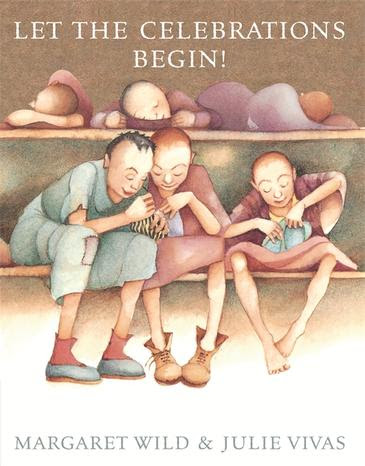
Things are very hard for everyone in the Gurs camp but I kept expecting harsher descriptions of the starvation and inhumane conditions. Parts of the story were filled with tension for example when Klara is used to demonstrate the awful Nazi doctrine in class and when everyone is forced to leave their suitcases on the station platform but if you have a sensitive reader this book is nowhere near as harsh or confronting as other holocaust middle grade novels. Older students could compare the conditions in the Gurs camp with those described in Let the Celebrations Begin.


Companion books:


Tuesday, November 11, 2025

Seedfolks by Paul Fleischman


AMIR: The garden’s green was as soothing to the eye as the deep blue of that rug. I’m aware of color—I manage a fabric store. But the garden’s greatest benefit, I feel, 
was not relief to the eyes, but to make the eyes see our neighbors.

This book is such an interesting discovery. It is a book for Young Adult readers but I am sure adults will enjoy the way this book is written as a jigsaw puzzle where we meet a diversity of characters all linked through their connection with a community garden. (In the UK this might be called an allotment). Seedfolks was published in 1997 - I read an ebook version. The good news is the paperback [9780064472074] from 1999 seems to be available to order from your favourite independent book seller.

Publisher blurb: A Vietnamese girl plants six lima beans in a Cleveland vacant lot. Looking down on the immigrant-filled neighborhood, a Romanian woman watches suspiciously. A school janitor gets involved, then a Guatemalan family. Then muscle-bound Curtis, trying to win back Lateesha. Pregnant Maricela. Amir from India. A sense of community sprouts and spreads. 

Characters
  • Kim: A Vietnamese girl mourning her father, who plants beans to connect with him.
  • Ana: An elderly Romanian woman who initially distrusts Kim but later helps tend the garden.
  • Wendell: A school janitor who supports Kim and contributes to the garden.
  • Gonzalo: A young Guatemalan boy who feels responsible for his uncle and finds purpose in gardening.
  • Curtis: A muscle-bound man trying to win back his ex-girlfriend through gardening.
  • Leona: A passionate woman who fights to clean the lot and grows goldenrod, believing it has healing properties.
  • Maricela: A pregnant teen who learns to care for plants and finds hope for her future.
  • Amir: An Indian immigrant who grows eggplant, sharing his heritage with others in the community.
  • Tío Juan: Gonzalo’s uncle, a farmer who finds joy in sharing his knowledge with children.
  • Sae Young: A Korean woman who finds solace among neighbors as she tends to the garden.

Here is the Kirkus review. There is a link to book club questions on the publisher web page. Wikipedia have more plot details. 

Listen to a discussion about his book with All Things Considered.

Quick facts (Source Audible blog)

  • Seedfolks features 13 distinct narrators, each telling their own chapter of the story.
  • Despite its large and diverse cast of characters, the book is only 80 pages long.
  • The story is set in Cleveland, Ohio, and spans one year, from the planting of the first seeds to the following spring.
  • Seedfolks was named an ALA Best Book for Young Adults in 1998 and won the Buckeye Children's Book Award for ages six to eight in 1999.
  • Seedfolks has been adapted into a play and performed on Broadway.
  • The audiobook version features 13 different voice actors to represent each character.
Here are a few text quotes:

KIM: All his life in Vietnam my father had been a farmer. Here our apartment house had no yard. But in that vacant lot he would see me. He would watch my beans break ground and spread, and would notice with pleasure their pods growing plump. He would see my patience and my hard work. I would show him that I could raise plants, as he had. I would show him that I was his daughter.

WENDELL: There’s plenty about my life I can’t change. Can’t bring the dead back to life on this earth. Can’t make the world loving and kind. Can’t change myself into a millionaire. But a patch of ground in this trashy lot—I can change that. Can change it big. Better to put my time into that than moaning about the other all day. That little grammar-school girl showed me that.

LEONA: There were probably lots of folks who’d want to grow something, just like me. Then I studied all the trash on the ground. Don’t know why anyone called that lot “vacant.” The garbage was piled high as your waist, some of it from the neighborhood and some dropped off by outside people. The ones who don’t want to pay at the dump, or got dangerous chemicals, or think we’re such slobs down here we won’t mind another load of junk. ...  The gardeners had made some trails through it. But I knew precious few would join ’em until that mess was hauled away.

NORA: That small circle of earth became a second home to both of us. Gardening boring? Never! It has suspense, tragedy, startling developments—a soap opera growing out of the ground. I’d forgotten that tremolo of expectation produced by a tiny forest of sprouts. What a marvelous sight it was to behold Mr. Myles’ furrowed black face inspecting his smooth-skinned young, just arrived in the world he’d shortly leave. His eyes gained back some of their life. He weeded and watered with great concentration.

Paul Fleischman grew up in Santa Monica, California. The son of well-known children's novelist Sid Fleischman, Paul was in the unique position of having his famous father's books read out loud to him by the author as they were being written. This experience continued throughout his childhood. Paul followed in his father's footsteps as an author of books for young readers, and in 1982 he released the book "Graven Images", which was awarded a Newbery Honor citation. In 1988, Paul Fleischman came out with "Joyful Noise: Poems for Two Voices", an unusually unique collection of poetry from the perspective of insects. This book was awarded the 1989 John Newbery Medal. Factoring in Sid Fleischman's win of the John Newbery Medal in 1987 for his book "The Whipping Boy", Paul and Sid Fleischman became to this day the only father and son authors to both win the John Newbery Medal.


Sunday, June 22, 2025

One Day by Michael Rosen illustrated by Benjamin Phillips


"A true story of courage and survival in the holocaust"


Begin here where Michael Rosen talks about his book.

Michael Rosen was commissioned to write this book. He had been researching what happened to his father's uncle and aunt in France during the holocaust. "They didn't come back."

Publisher blurb: “Get through one day and then on to the next. One day at a time. One day after another.” Eugène Handschuh was a Jewish member of the Resistance in occupied Paris. After he was captured by the Nazis, he was placed on a convoy to Auschwitz. Against all the odds, with the help of strangers and fellow members of the Resistance, Eugène and his father escaped the convoy and survived – when so many others did not. Former Children's Laureate Michael Rosen was inspired to tell this story after discovering his father’s uncle and aunt were on the same convoy as Eugène but never returned. With powerful illustrations from Benjamin Phillips, whose work has been shortlisted for the Carnegie Medal for Illustration, this sensitive true-story picture book reminds us of the best of people, in the worst of times.

Rosen uses a refrain to capture the determination of Eugène and his fellow prisoners: ‘Get through one day and then on to the next. One day at a time. One day after another.’ Elsewhere, Rosen celebrates other forms of courage, for instance the French couple who put themselves at risk to hide Eugène’s father. ‘I’ve never forgotten them,’ Eugène tells us, inviting us also to pause and reflect on their selflessness. This would be an excellent book to share with readers across the primary age range, particularly around Holocaust Memorial Day: for younger readers it introduces the topic in a safe and respectful way, and might lead into discussions around how we treat those who are different from us; for older readers it might inspire further research into Handschuh or other members of the Resistance. Just Imagine

Companion books:


I am also keen to find Stone Angel by Jane Yolen; The Whispering Town by Jennifer Elvgren; What Rosa Brought by Jacob Sager Weinstein; and The Harmonica by Tony Johnston.


Monday, June 16, 2025

When we flew away by Alice Hoffman


Bookseller blurb: Anne Frank's The Diary of a Young Girl has captivated and inspired readers for decades. Published posthumously by her bereaved father, Anne's journal, written while she and her family were in hiding during World War II, has become one of the central texts of the Jewish experience during the Holocaust, as well as a work of literary genius. With the Nazi occupation of the Netherlands, the Frank family's life is turned inside out, blow by blow, restriction by restriction. Prejudice, loss, and terror run rampant, and Anne is forced to bear witness as ordinary people become monsters, and children and families are caught up in the inescapable tide of violence. In the midst of impossible danger, Anne, audacious and creative and fearless, discovers who she truly is. With a wisdom far beyond her years, she will become a writer who will go on to change the world as we know it. 

I have a few dilemmas about recommending this book. Yes, it is an engrossing read although at times it felt a little repetitive. But who should read this book? I think you do need to be familiar and even better to have recently read The Diary of Anne Frank. But then do fans of The Diary of Anne Frank want a book like this which, even though it has been researched, it is a work of imagination - imagining the Frank family and especially Anne in the years before the family went into hiding. I think one of my conclusions is this book should only be read after you have met Anne Frank through her diary and if you are curious about life in Amsterdam during the Nazi occupation and of course you want to know a little more about the Frank family - their life and in the case of Anne her deepest thoughts.

Historical information woven into the narrative serves as time stamps as the Franks move ever closer to their life in hiding. This context is helpful for readers and offers a startling reminder of the terror that took over Europe during World War II. Ultimately, Hoffman portrays Anne and Margot as the children they truly were, gripped with fear and telling each other stories for comfort but still eager to go for bike rides, celebrate birthdays, and try to live their lives fully. This novel serves as an insightful companion for Frank’s own diary or as a stand-alone entry into a terrifying and unforgivable time in history. Kirkus

There is a QR code on this Scholastic flyer which takes you to the first chapter. Listen to an audio sample. Here are a set of questions to use with a book group. Read more plot details here. When we flew away is published in cooperation with The Anne Frank House. You can see more Adult andYA books by Alice Hoffman here. I previously read and enjoyed Night Bird. 

Use my label Anne Frank to discover other books I have shared about Anne Frank. Companion book:


(Sorry, this is now out of print)
Here is the Kirkus review


Sunday, June 15, 2025

Not Nothing Gayle Forman


Before I start, I want to make it clear. He did something bad. Truly bad. I don’t want you to think I’m sidestepping that, or excusing it, or even forgiving it; it’s not for me to forgive, anyhow. But I’m telling you the story so you understand how he got where he did and how I got where I did and how both of us learned to rise to the occasion of our lives.

Alex, aged 12, has done something truly awful. The judge is giving him one more chance or one more opportunity. Alex hates that word and it's one the adults seem to use way too often. Now he finds himself at the Shady Glen retirement home: The Shady Glen residents were the living waiting to die. Places like Shady Glen are antechambers of death, the last stop where you wait for the Last Stop.

Because, honestly, no one had asked him if he wanted to be here. No one had asked him if he wanted another stupid opportunity. But, remembering what the judge had said about him throwing away chances ...

Alex is assigned work in the care home. He finds the residents weird and scary but even worse there is a young girl named Maya Jade also aged 12 who is working there - not as a community service order but as a volunteer - and she is bossy and opinionated and very annoying. The facility goes into lock down and Alex is sent to deliver meals to the residents. He meets Joseph “Josey” Kravitz aged 107 AND we meet him too because this book uses that appealing plot style of alternating voices so we can hear what Alex thinks and hear Josey. This is lucky in two ways because Josey is nonverbal (at least at the beginning of the book) and Josey is able to share the things he really 'sees' about Alex. Josey also opens up to Alex and over the following months he shares his own story - a harrowing story of love, loss and the holocaust.

Alex is suffering at home. He has been sent to live with his aunt and uncle. They are cold, disinterested and show Alex no love or affection. So 'home' is a misery. 

He lived on a lumpy couch with an aunt and uncle who did not want him. He had a judge who had warned him of last chances. He might go to juvie. And his mom… He hadn’t seen her in almost a year. He didn’t know if or when he would ever see her again. How could it get more permanently bad than this?

And the new school is also terrible. 'They' decide Alex is failing and so he is given special tutoring in maths. Alex is good at maths but he has totally switched off because everything in his life is so broken. He is so angry about the tutoring and the tutor. 

This book was published in 2024 and so here in Australia the hardcover edition is priced way beyond a school library budget. I read my copy on a Kindle but hopefully a paperback will arrive eventually. Not Nothing has won a Banks Street Award - Josette Frank Award 2025.  The Josette Frank Award for a work of fiction of outstanding literary merit for young readers in which children or young people deal in a positive and realistic way with difficulties in their world and grow emotionally and morally.

There is a raw honesty in this story - both in the story from Josey and from Alex. I cannot tell you exactly what Alex did but even though it is dreadful Gayle Forman has crafted a story that builds our empathy. I highly recommend Not Nothing for readers aged 12+.

Best-selling award winner Forman interweaves the tales carefully, with striking language and depth of feeling, allowing readers to understand the characters’ changing perspectives as they learn more about themselves and open up to people around them, many of whom become advocates and friends. Powerful, heartbreaking, and hopeful. Kirkus Star review

Book seller blurb: Alex is twelve, and he did something very, very bad. A judge sentences him to spend his summer volunteering at a retirement home where he's bossed around by an annoying and self-important do-gooder named Maya-Jade. He hasn't seen his mom in a year, his aunt and uncle don't want him, and Shady Glen's geriatric residents seem like zombies to him. Josey is 107 and ready for his life to be over. He has evaded death many times, having survived ghettos, dragnets, and a concentration camp--all thanks to the heroism of a woman named Olka and his own ability to sew. But now he spends his days in room 206 at Shady Glen, refusing to speak and waiting (and waiting and waiting) to die. Until Alex knocks on Josey's door...and Josey begins to tell Alex his story. As Alex comes back again and again to hear more, an unlikely bond grows between them. Soon a new possibility opens up for Alex: Can he rise to the occasion of his life, even if it means confronting the worst thing that he's ever done?

Here are a few text quotes:

For three days the boy cleaned banisters, safety rails, doorknobs, coffee tables, more doorknobs, Rummikub sets, book spines, outdoor tables, indoor tables, outdoor chairs, indoor chairs. The bleach stung his eyes, scraped his throat, and stole his appetite. The baloney sandwich his aunt packed him went uneaten. He would’ve thrown it away except he couldn’t bring himself to throw away food.

But then, as the months dragged on, his mom started to go to one of her bad places. He could recognize the signs as easily as the freckles across the bridge of her nose. He’d wake up in the morning and find her in the same chair she’d been in when he’d gone to bed, the TV on the same channel, the dinner he’d left out for her cold on the table. She didn’t cook any meals or eat the ones he put together.

“You shouldn’t separate them, because they love each other,” he continued in a halting voice. ...  So many people in Shady Glen had lost the people they loved, because their spouses had died or their children had moved away. When the people you loved left, that love remained, floating around, desperate for a place to go. And if it didn’t find a place to go… bad things happened. Love turned into anger, fear, hate. This was something the boy at twelve knew all too well. How did the grown-ups not see this?

“I’ll tell you why!” The words felt like a rocket countdown. Ten, nine, eight… “Because everyone who has promised me an opportunity has just made things worse. When I told the people at my old school about me and my mom, they all congratulated me on doing the right thing. Because now they had an opportunity to get us some help. I thought they meant food.” His voice began to crack, but the rocket was lifting off now, and there was no turning back. “But you know what they did? They made me go live with strangers and dragged my mom to a hospital and told her she’d have to get better if she wanted to be my mom. But if you know my mom like I do, you know she can’t stand to be stuck in one place. It’s why she moved so much. It’s why during the lockdown she got so much worse.”

I have also read this story where an elderly character also shares their holocaust experience. This one is for a slightly young audience - 10+.


Friday, June 13, 2025

Tree Table Book by Lois Lowry


"I'm going to tell you three words. I'm choosing them at random. Listen carefully. This will be important.
House.
Umbrella.
Apple.
Remember those. I'll explain later."

Sophia (known as Sophie) is aged eleven and her best friend is Sophie Gershowitz. Sophie is eighty-eight years old and she lives next door to Sophia. Sophia wants to tell us the story of Sophie. Sophia once received some advice about writing: "Begin on the day that is different."

Ralph is a kid in her neighborhood. Ralph's dad is a pediatrician and so he owns a copy of The Merck Manual which is a reference book for doctors. And there is Oliver who is seven and on the autism spectrum. So, Sophia has three friends - Sophie her Friend of the Heart; Ralphie her same age friend; and Oliver.

Sophia loves check the Merck. Sophia needs the Merck because she has overheard a conversation about her best friend Sophie's health. Sophia is also a medical hypochondriac and her medical dilemmas are sure to make you laugh.

"There is something about a book; the feel of it, the weight of it in your hands, the way the pages turn (pages in the Merck are very thin and extremely serious-seeming, the cover is leather, and there are built-in index tabs."

Aaron, Sophie's son, is coming from Akron. Sophia's parents tell her Sophie will take a test to check her memory or we would say cognition. This gives Sophia  a brilliant idea. She can help Sophie pass this test - all it will take is some training. Sophia is sure Sophie has good eyesight and good hearing but sometimes she seems to miss smells and often Sophie finds very stinky things in her fridge. She also sometimes forgets to turn off her kettle. 

If you have an elderly parent or grandparent you might be familiar with the tests for dementia - one of the questions involves remembering three objects - hence the title of this book - the short-term memory test. Over several days, as Sophia asks the test questions, we gain an insight into Sophie and her life in Poland, her husband, and the holocaust. Sophia uses the three-word test as a way for Sophie to recall her childhood and Sophie tells three stories - the tree with the berries picked too soon by the children; the table at the baker shop that Sophie was not allowed to visit; and the book of fairy tales that her mother returned to the rich owner - the house where Sophie was hidden over the war years.

Lowry is famous for dealing with difficult subjects in her work, which has occasionally been banned, and as young Sophie encourages older Sophie to delve into her long-term memories, it becomes clear that this is also a novel about surviving the Holocaust. Three brilliantly told stories from Sophie’s Polish childhood form the climax of the novel, contrasting very effectively with young Sophie’s charming, insouciant 21st-century kid voice (captured to perfection by the 87-year-old Lowry). The Historical novel society

When the test prep unlocks memories of Sophie G.’s childhood in Poland during World War II, Lowry conveys with sensitivity and realism Sophie W.’s sorrow upon realizing that things she’s only learned about in school have had a painful, lifelong impact on her beloved friend. Book Page

Read more plot details here.

Readers aged 10+ who enjoy personal stories and stories about kindness are sure to enjoy Tree Table Book. Sophia has such a determined attitude and voice. You should also look for these in your local or school library:


Wednesday, June 4, 2025

Max in the House of Spies by Adam Gidwitz


Max is an only child living in Berlin with his parents - his father is a watchmaker and his mother takes in clothes that need alterations and repairs. They are not wealthy but they are happy.  But this is a Jewish family, the year is 1939 and it is clear they are all in danger then comes the dreadful night - the event named Kristallnacht. His mother and father have been negotiating to send Max away and now this is urgent. Max absolutely does not want to leave his parents but they take him to the train and he sets off to England. He is taken in by a wealthy Jewish family, the Montagus, so culturally things feel slightly 'normal' but all Max wants to do is to find a way back home.

Max is a child genius. He can solve complex problems and he is an expert with radios. At school he has a problem with horrid bullies - he solves this using his brain. Also at school he is expected to take part in a brutal rugby game - again he solves this using his brain - I adored what he did to avoid this match. Over time his actions come to the attention of the uncle in his adopted family. Uncle Ewan is actually a Lieutenant Commander who works for British Naval Intelligence. He is the person who takes Max to a set of houses and a mansion owned by the wealth Rothschild family and this is the place where his training begins. Max is being trained to be a spy - to go back to Berlin and potentially do something involving radios - we don't know much about this in the first installment. For now, Max just has to pass this training in fact he has to be extraordinary.

Spoiler alert- I devoured this book in just one day BUT I have to give a huge warning. The final page is a total cliff hanger - Max arrives outside Berlin after being dropped from a plane on a parachute but his guide is lying dead on the ground. Luckily there are only two books in this series so I anticipate things will be resolved in the next installment and hopefully Max will be safe and (do I dare to hope for a fairy tale ending) reunited with his Mama and Papa. While we are in a spoiler paragraph here, I should also mention Max does meet Winston Churchill - this is another scene that is so well written. 

The suggested age range for Max and the House of Spies is 8-14 - that in my opinion is ridiculous. I highly recommend Max and the House of Spies for mature readers aged 11+. Notice the label 'Magical Realism'. Max has two little characters on his shoulders - you can see them on the cover. The reviewer at the School Library Journal explains them this way: Berg is a kobold (from Merriam-Webster: an often mischievous domestic spirit of German folklore) and Stein is a dybbuk (from the Jewish Virtual Library: an evil spirit which enters into a living person, cleaves to his soul, causes mental illness, talks through his mouth, and represents a separate and alien personality).To me they represented optimism and pessimism, and also at times they feel like a way to hear Max's own thoughts. Whatever their role I loved the way they added humour to some incredibly tense and dangerous situations. 

Australian children will enjoy the inclusion of a kangaroo (yes this will be a surprise) but we would want her to eat vegemite not marmite but I guess there would not be any vegemite in the UK in 1940.

This book is a hilarious page-turner that successfully raises, but does not solve, the problem of evil. It’s also a well-researched historical novel that eventually sends Max to British spy school. He’s trained for undercover work in Nazi Germany, smuggled back to Berlin… and then something truly awful happens, leaving the reader hanging. Historical Novel Society

Fun, fact-filled, exciting, and unafraid to ask the tough questions, dip deep into this one when you can. Then get ready to want to read the next one immediately. Fuse 8 Betsy Bird - read this whole review Betsy gives some really great insights into this book. 

True to its title, this is a book about spy craft and espionage during World War II. But it's also a book about figuring out who you are and about being true to that person once you do. This is a book about history, antisemitism, bullying and the dangers of group think. It's about friendship and families: those you are born into and those you choose. But most of all, Max In The House of Spies is a book about love. Library Girl

Check out my very recent post about the Kindertransport. 

Here is the sequel to Max in the House of Spies - and YES I will begin reading it tonight because I just cannot leave Max stranded in that field near Berlin.


Monday, June 2, 2025

In a Flash by Donna Jo Napoli


“Stay alert. Always. Pay attention to everything and everyone. Pay attention to how things are done in your new country. Be kind. Be grateful. Smile a lot. Take care of each other.” ...
“Forza e coraggio—that will be your motto.” 
Forza e coraggio. Strength and courage. I close my eyes and still my heart. We can do this."

In a Flash is a gripping story and a page turner. I kept hoping I was going to be totally wrong about the ending - and then it happened - have you guessed what the title means? This book is set out in chronological chapters beginning on 24th July 1940. 

Simona and Carolina have lost their mother. Their father is a chef and he accepts an invitation to work at the Italian embassy in Tokyo. That should be an interesting experience for the young girls aged eight and five but the year is 1940. Students of history know there are three important and dreadful events associated with this time. World War II has begun. Italy has sided with Germany and Hitler but this will change. Japan will be drawn into the war after the bombing of Pearl Harbour and yes, we are heading for the dropping of the atomic bomb on Hiroshima and later Nagasaki. It is war time so there is also rationing to contend with and remember Papa is a chef and the Italian Ambassador and his wife demand Italian food. As very young children both girls learn the new language of Japanese fairly easily and Simona especially picks up lots of cultural nuances which help her greatly as the navigate their new lives. 

When the allegiances change Italy becomes the enemy. Papa is taken to a internment camp and the girls are taken to a house with other foreigners. The did have a suitcase each at the beginning of their journey but Simona's suitcase is lost - this is such a heart-breaking scene. eventually the girls escape their 'imprisonment' and so begins a journey across Japan always hoping they can be reunited with their father. Their journey ends in Hiroshima. They arrive on 27th May 1945. In a few weeks time an unimaginable event will happen. Simona is nearly fourteen and her sister is nearly eleven. The final chapter of this book is dated 6th August 1965. 

A blinding light invades the room. Then a roar louder than any train, and we’re thrown to the ground. I climb on top of Karo-chan to protect her as things crash down on all sides. I cradle my head in my arms and wait. After a few minutes things stop flying through the air. Everything is quiet. And dark as night.

Her are some text quotes from In a Flash:

He sat me down and explained that because of the Pact of Steel, Germany’s enemies were Italy’s enemies; Germany was at war with France and Great Britain, so Italy was, too.

So that’s what this cloth is called. I untie the furoshiki, and there’s a rice ball, cucumber strips, and carrot chunks sitting in the middle. I know rice balls from home. I take a bite, but it’s nothing like in Italy—no cheese inside, no tomato, no peas. I take a nibble. Sweet. I nibble till it’s all gone. Then I eat the vegetables, which turn out to be pickled.

A couple of months ago, at the end of September, Italy and Japan and Germany signed a big agreement—the Tripartite Pact—and the next week the ambassador went to a huge party at some palace.

“When America declares war on Japan, Italy will declare war on America,” Papà says. “Remember the Tripartite Pact, Simona? Germany, Italy, and Japan fight together. The enemy of one is the enemy of all three.”

“A big, responsible Italian girl who knows Japanese as well as anyone.” He leans over a little. “My interpreter might not tell me things he doesn’t want me to know. I get the feeling sometimes, when he’s translating newspapers, that he skips things.

No one expects to see Western children here—so no one does. As long as we talk right and behave right, people think we are who we pretend to be. Language matters more than the shape of eyes. But if anyone looks too hard, we’ll get caught.

Staying alive is a game of wits. People often tell me that I’m clever, but right now I feel stupid. Staying alive is also a game of luck. So much depends on luck. Three women in a cabin in the woods. A blind washerwoman. But luck can run out.

We’ll go to Kyoto. They bombed Kobe and Osaka, but they won’t bomb Kyoto. Not beautiful Kyoto. They’ll want to preserve it so they can visit it as tourists in the future. That’s how Americans think.

This is good. I know where they can go. There’s a Catholic mission in Hiroshima where priests go after their own missions are bombed out. They only do this with priests who are friends of Japan. German priests.

In a Flash is a long book with 400 pages. I read my copy on a Kindle so I was able to read this book over just two days but for readers aged 11+ they will need some reading stamina. In a Flash was published in 2021 and so far, it is only available in hardcover so here in Australia it is priced at over AUS$30. Here is the website for Donna Jo Napoli.

It took me a little while to get into the rhythm of the first person narration but once I did I was hooked. The dates at the start of each chapter really drove the plot for me. I loved the kindness shown to the girls by strangers especially by the blind washerwoman. I also really appreciated the deep intelligence of Simona as she navigates her new culture. This book will give readers such an interesting insight into a different aspect of World War II and a very different perspective about life in Japan during those years especially the control of the media and the use of propaganda and indoctrination. 

Through the voice of Simona, this novel offers an unusual perspective on the World War II years in Japan. The girls’ journey is constantly challenging, as they often face sudden, unexpected risks. Because the story spans multiple years, there is a lot of information about Japan’s home front experience during the 1940s, including patriotism, propaganda, underground anti-war efforts, depletion of resources, and bombings. Topics of xenophobia, identity, assimilation, loss, friendship, and family are intertwined through the perspective of a young person navigating tumultuous events. Kirkus

Companion books:


Tuesday, May 20, 2025

Martin and Anne by Nancy Churnin illustrated by Yevgenia Nayberg


Subtitle - The Kindred Spirits of Dr Martin Luther King, Jr. and Anne Frank


Martin and Anne shows the links between these two lives. Both were born in 1929. Both experienced discrimination and unkindness and dreadful hatred in their lives. Both left us an important legacy of their words about peace and generosity and equality.

Compare their lives:

Martin has to go to a different school from his friend.
Anne's family flee Germany and move to Holland. After the Nazi's invade, Anne's school is closed.

Martin's community is filled with signs that say 'Whites only'.
Anne has to wear a yellow star and she cannot buy an ice cream or see a movie.

Martin, even as a young boy, is good at making speeches.
Anne has plenty to say and she does this in her diary because her family have had to go into hiding.

"Martin decided to become a minister who would lead his people to stand for justice."
"Even with all the hate around her, Anne believed that people were really good at heart."

Martin won the Nobel Peace Prize when he was 35. He was killed when he was just 39.
Anne died aged 15 but her diary became a worldwide best seller.

A surprisingly successful and enlightening combination strengthened by striking artwork. Kirkus

Yevgenia Nayberg is an award-winning author/illustrator, painter, and stage designer. Her debut author/illustrator picture book, Anya's Secret Society, received a Junior Library Guild Gold Selection Award. She’s an author/illustrator of Typewriter and Mona Lisa In New York.  Her latest book, I Hate Borsch!, is the Gold Winner of the 2022 Foreword Indies Book of the Year Awards. Born and raised in Kyiv, Ukraine, she now lives in New York City.

Nancy Churnin is a children’s book author who writes about people that have made the world better and inspire kids to be heroes and heroines, too. Additional honors include the 2021 National Jewish Book Award; 2022 Sydney Taylor Honor and Sydney Taylor Notables in 2022 and 2019; four Social Studies Notable Trade Books for Young People; the 2018 South Asia Book Award; two Children and Teen’s Choice Book Awards finalists; two Junior Library Guild selections; starred reviews from School Library Journal; Kirkus Reviews and Publishers Weekly; and multiple state book lists. She lives in Texas.

I first spied this book, Anne and Frank, in 2021 (it was published in 2019) and so I have had it on my 'wish list' for five years. Every so often I check the price which unfortunately never seems to come down.  I am collecting and purchasing books for a presentation at a forthcoming Teacher-Librarian conference. Yes, I have probably spent way too much of my own money (over AUS$300+ so far). Martin and Anne is set at AUS$35 which is over my usual price limit but I was sure this book would be splendid, and I was right. Here are some teachers notes for Martin and Anne. In this video you can see the author Nancy Churnin. Read a Nerdy Book Club interview.

In my former school library I read other books about Anne Frank in Term Four to Grade 6 such as these:


And about Martin Luther King Jr and events around his life I would read these to my Grade 6 groups:


It would be fantastic to share this book Martin and Anne with a group of students in your library - they could be quite young aged 7+ or up to high school level. With the youngest children I would begin by sharing these two books:


Little Martin grew up in a family of preachers: his dad was a preacher, his uncle was a preacher, his grandfather was a preacher…so maybe he’d become a great preacher too. One day, a friend invited him to play at his house. Martin was shocked when his mother wouldn’t let him in because he was black. That day he realized there was something terribly unfair going on. Martin believed that no one should remain silent and accept something if it's wrong. And he promised himself that—when he grew up—he’d fight injustice with the most powerful weapon of all: words.


Anne Frank was born in Germany to a loving family. But when World War II broke out, Anne and her family had to hide in a secret annex in Amsterdam. Here, Anne wrote her famous diary, describing her belief in people's goodness and her hopes for peace. After the war, her diary captured the hearts of the public and she became one of the most important diarists of the 20th century. (Teacher's Guide)


It would be a brilliant lesson if your students selected two other books from the Little People Big Dreams series and, using Martin and Anne as a model, they then created their own joined story. For example Neil Armstrong and Katherine Johnson OR David Attenborough and Jane Goodall.

I previously talked about this book by Nancy Churnin: