Showing posts with label Novella. Show all posts

Sunday, May 31, 2026

Following Grandfather by Rosemary Wells illustrated by Christopher Denise


"It was Grandfather who taught me the names of all the shells: luck shells, boat shells, comb shells, winkles, and the rare queen's teacup, which washes up only once in a blue moon."


Jenny and her grandfather like to visit their local beach - Revere Beach in Boston - and yes this is a real place.


Her grandfather came to the US from Italy and as a young man worked in an Italian restaurant. Now he has retired and Jenny's parents run the restaurant. Grandfather has the time to look after and share his wisdom with Jenny but sadly he is coming to the end of his life.

Here is a special extract from this story:

"My parents worked late into the night, so it was Grandfather who spooned warm milk over my evening pudding. It was his hand that showed me how to button my buttons and how to draw J for Jenny. Into Grandfather's vest pocket went my first tooth, and to the ticking of his pocket watch I slept."

And my favourite scene is when Grandfather takes Jenny to the Jordan Marsh and Fliene department store. 

"There the latest fashions from Paris and Milan are copied exactly from the downstairs models. They are painstakingly sewn from sippets of silk and organza stolen from the main racks at night. ... I tried on every outfit and modeled them for Grandfather. He sat patiently, leaning on his mother-of-pearl tipped walking stick and examining the tailoring carefully, as if we could have afforded them."

Two names jumped out at me from the cover of Following Grandfather - Rosemary Wells (author of all those wonderful books about Max and Ruby) and Christopher Denise (illustrator of Knight Owl).


Bookseller blurb (this book is from 2012 and so is now out of print): 

Invisible to humans exists a parallel world of mice, where young Jenny misses her cherished grandfather so much that she begins to see him everywhere. Jenny is as close to her grandfather as a small mouse can be. Grandfather shows Jenny how to button her buttons and how to write her name. He passes along to her the secrets of making the best lasagna in all of Boston. And during long, shared days at Revere Beach, Grandfather teaches Jenny the names of the seashells they find washed up on shore. When Grandfather is all of a suddenly gone one day, the hole he leaves behind is too great for Jenny to fathom. Isn’t that him turning a corner, sitting on a bench, heading for the pier, walking along their beloved beach? Jenny runs after the familiar silver whiskers, hoping. ... Rosemary Wells peels back the layers of grief to reveal, at its core, something as exquisite and achingly beautiful as the rare and storied queen’s teacup seashell. Christopher Denise illustrates mid-century Boston with affection, and a mouse and her grandfather with gentle humor and unabashed sympathy.

This time spent together - old and young - made me think of this wonderful picture book:


I am an adult and I need to say that there is so much in this book that appeals to me, but I am not entirely sure if this is a book for very young readers. Not because of the content, even though the grandfather does die, but more because of the references to American culture and history and also the exploration of the concept of class and privilege. This quote explains this idea:

"I learned all the mice in the city and what they did to make a living. Grandfather tipped his hat to Senator Lodge himself and to the Cabot nursemaids, the fried-seed vendor, and the poorest rat who swept the sewers. Grandfather said hello to the world. I learned to say hello, too, in that way that made the world smile back."

Rosemary Wells expresses in a beautiful way sandcastles that are swept away by a rising tide - she calls them melting sandcastles and she also uses the delightful words 'crenellated tower' to describe the inside of one sandcastle. And you will want to think about the meaning of the title. And I do love the idea of collecting special shells. 

Following Grandfather has 58 illustrated pages so it is a very quick book to read but if you read this book aloud in your family you may find yourself explaining these things:

  • Meaning of the word 'revere': to be in awe of and respect deeply; venerate
  • Places - Revere Beach in Boston; Holy Cross Cathedral on Washington Street; Martha's Vineyard.
  • Italian foods - biscotti, gelato, mozzarella, cappolatte anisetto, tortellini, lasagna puttanesca
  • Riding in a streetcar (we might call this a tram).
  • Ship names 'Leonardo da Vinci'; Titanic; Carpathia and you will want to explore the sinking of the Titanic in more detail.
  • Grandfather wears spats and has mother of pearl buttons

My friend from Kinderbookswitheverything explains her reservations about the audience for Following Grandfather in her blog post. 

Beautifully written text and endearing gray-scale illustrations transport readers and add to the poignancy of the tale. The message that all people are worthy of respect is artfully delivered and the manner in which Jenny mourns her grandfather's death will evoke empathy from young readers who have suffered a similar loss. School Library Journal

Losing someone you love is always painful, but for the young such a loss can be devastating and incomprehensible. In this beautifully written and illustrated story, we come to appreciate how special Jenny’s grandfather is, and we see how the little mouse struggles to come to terms with her grief. Through the Looking Glass

Writing with tenderness and humor, Wells creates an authentic, parallel, mouse-sized world within Boston while introducing readers to human-sized devotion and grief in the fully developed relationship between Jenny and Grandfather. Kirkus

I do enjoy books about mice that incorporate the human world such as these:


Tuesday, November 11, 2025

Seedfolks by Paul Fleischman


AMIR: The garden’s green was as soothing to the eye as the deep blue of that rug. I’m aware of color—I manage a fabric store. But the garden’s greatest benefit, I feel, 
was not relief to the eyes, but to make the eyes see our neighbors.

This book is such an interesting discovery. It is a book for Young Adult readers but I am sure adults will enjoy the way this book is written as a jigsaw puzzle where we meet a diversity of characters all linked through their connection with a community garden. (In the UK this might be called an allotment). Seedfolks was published in 1997 - I read an ebook version. The good news is the paperback [9780064472074] from 1999 seems to be available to order from your favourite independent book seller.

Publisher blurb: A Vietnamese girl plants six lima beans in a Cleveland vacant lot. Looking down on the immigrant-filled neighborhood, a Romanian woman watches suspiciously. A school janitor gets involved, then a Guatemalan family. Then muscle-bound Curtis, trying to win back Lateesha. Pregnant Maricela. Amir from India. A sense of community sprouts and spreads. 

Characters
  • Kim: A Vietnamese girl mourning her father, who plants beans to connect with him.
  • Ana: An elderly Romanian woman who initially distrusts Kim but later helps tend the garden.
  • Wendell: A school janitor who supports Kim and contributes to the garden.
  • Gonzalo: A young Guatemalan boy who feels responsible for his uncle and finds purpose in gardening.
  • Curtis: A muscle-bound man trying to win back his ex-girlfriend through gardening.
  • Leona: A passionate woman who fights to clean the lot and grows goldenrod, believing it has healing properties.
  • Maricela: A pregnant teen who learns to care for plants and finds hope for her future.
  • Amir: An Indian immigrant who grows eggplant, sharing his heritage with others in the community.
  • Tío Juan: Gonzalo’s uncle, a farmer who finds joy in sharing his knowledge with children.
  • Sae Young: A Korean woman who finds solace among neighbors as she tends to the garden.

Here is the Kirkus review. There is a link to book club questions on the publisher web page. Wikipedia have more plot details. 

Listen to a discussion about his book with All Things Considered.

Quick facts (Source Audible blog)

  • Seedfolks features 13 distinct narrators, each telling their own chapter of the story.
  • Despite its large and diverse cast of characters, the book is only 80 pages long.
  • The story is set in Cleveland, Ohio, and spans one year, from the planting of the first seeds to the following spring.
  • Seedfolks was named an ALA Best Book for Young Adults in 1998 and won the Buckeye Children's Book Award for ages six to eight in 1999.
  • Seedfolks has been adapted into a play and performed on Broadway.
  • The audiobook version features 13 different voice actors to represent each character.
Here are a few text quotes:

KIM: All his life in Vietnam my father had been a farmer. Here our apartment house had no yard. But in that vacant lot he would see me. He would watch my beans break ground and spread, and would notice with pleasure their pods growing plump. He would see my patience and my hard work. I would show him that I could raise plants, as he had. I would show him that I was his daughter.

WENDELL: There’s plenty about my life I can’t change. Can’t bring the dead back to life on this earth. Can’t make the world loving and kind. Can’t change myself into a millionaire. But a patch of ground in this trashy lot—I can change that. Can change it big. Better to put my time into that than moaning about the other all day. That little grammar-school girl showed me that.

LEONA: There were probably lots of folks who’d want to grow something, just like me. Then I studied all the trash on the ground. Don’t know why anyone called that lot “vacant.” The garbage was piled high as your waist, some of it from the neighborhood and some dropped off by outside people. The ones who don’t want to pay at the dump, or got dangerous chemicals, or think we’re such slobs down here we won’t mind another load of junk. ...  The gardeners had made some trails through it. But I knew precious few would join ’em until that mess was hauled away.

NORA: That small circle of earth became a second home to both of us. Gardening boring? Never! It has suspense, tragedy, startling developments—a soap opera growing out of the ground. I’d forgotten that tremolo of expectation produced by a tiny forest of sprouts. What a marvelous sight it was to behold Mr. Myles’ furrowed black face inspecting his smooth-skinned young, just arrived in the world he’d shortly leave. His eyes gained back some of their life. He weeded and watered with great concentration.

Paul Fleischman grew up in Santa Monica, California. The son of well-known children's novelist Sid Fleischman, Paul was in the unique position of having his famous father's books read out loud to him by the author as they were being written. This experience continued throughout his childhood. Paul followed in his father's footsteps as an author of books for young readers, and in 1982 he released the book "Graven Images", which was awarded a Newbery Honor citation. In 1988, Paul Fleischman came out with "Joyful Noise: Poems for Two Voices", an unusually unique collection of poetry from the perspective of insects. This book was awarded the 1989 John Newbery Medal. Factoring in Sid Fleischman's win of the John Newbery Medal in 1987 for his book "The Whipping Boy", Paul and Sid Fleischman became to this day the only father and son authors to both win the John Newbery Medal.


Saturday, April 12, 2025

I Believe in Unicorns by Michael Morpurgo illustrated by Gary Blythe


"Unicorns weren't actually real, I knew that much. Of course I did. It was quite obvious to me now that this was in fact a wooden unicorn. He had been carved out of wood and painted. But even as I came closer he seemed so lifelike. He looked so much how a unicorn should be, so magical and mysterious, that if he'd got to his feet and trotted off I still wouldn't have been in the least surprised."

Tomas Porec lives in a small town with his parents. One day his mum insists he wait in the local library while she completes her shopping. Tomas is sure he is way to old for the library story time but, in spite of his reservations, he does listen in from behind some shelves.

The library lady tells the story of Noah's Ark and how the unicorns were left behind and after struggling to find land during and after the flood, they transformed into the creatures we call Narwhals. Tomas is totally swept up into the story as are all the children. 

"For some time after she finished speaking a word. It was as if we were all waking up from a dream none of us wanted to leave."

Over the coming weeks Tomas goes to the library nearly every day. 

"Every story she told us, even it was one we'd heard before, held us enthralled. It was the way she told them, I think, as if each of us was the only one she was talking to, and as if each story must be real and true, however unlikely, however fantastical. You could tell she believed absolutely in her stories as she told them."

At one story session the library lady brings out a book that she says is her most special one.

"She held it up so we could all see. It looked rather old and tatty. The spine of the book was heavily taped, and the cover so stained that I found it difficult to read the title. And it was blackened too, at the edges, I noticed, as if it might have been scorched a long time ago."

I gasped when I 'heard' the library lady (now known as the Unicorn Lady) say the title - The Little Match girl. I hoped someone reading the book had not experimented with matches and caused all this damage. No that was not the story she told the children. The Unicorn Lady was a child during the holocaust. The Nazi soldiers burnt all the books from her town and library but her father heroically saved this one. 

All of that was in the past but then the story shifts to the present and war has come again. Tomas sees a plane dropping bombs. His family rush to safety but the library, his precious place, is on fire. Once the planes fly away everyone rushes to help forming a human chain to save the books and last of all Tomas and his father and the Unicorn Lady are able to retrieve the library unicorn. 

This novella sure does 'pack a punch'. Sadly, though, it was published in 2005 and is now long out of print. I do hope you can find a copy in a library. You can read the first few pages here. If you can find a copy of I Believe in Unicorns it would be a fabulous book to read aloud in a family to your children aged 8+. 

Michael Morpurgo pulls on the heart strings in a short book into which he has packed a number of strands, richly woven together. Tomas lives for the outdoors: he hates books, reading and stories. But one day, his mother forces him into the library and everything changes. Tomas hears the magical story of the unicorn and is soon spell bound by its power. Soon, reading and the wonderful stories that unfold before him become central to his life. But things are changing around Tomas too as the distant rumble of war is suddenly brought close to home. When his village suffers a direct hit, he realises what really matters to him. Morpurgo keeps on the right side of sentimentality and creates a sensitive boy hero. Love Reading for Kids

Companion book:


A few days ago I talked about another book by Michael MorpurgoThis Morning I met a Whale. My book today - I believe in Unicorns - has a similar format (not quite the same as the cover image at the top of this post) so I wondered if these two books might be part of a series. Alas I cannot find the name of the series I only know they were both published by Walker Books in the UK around 20 years ago. 

This Morning I met a Whale has illustrations by the wonderful Christian Birmingham. My book today is illustrated by the equally wonderful Gary Blythe. Here are three of his books:


Other editions of this book have the title Under the Moon


Thursday, March 27, 2025

This Morning I met a Whale by Michael Morpurgo illustrated by Christian Birmingham


Michael, as the title tells you, meets a whale. But whales are not supposed to be in his part of the river Thames. And whales are not supposed to be able to communicate directly with humans but this whale can and he has come specifically to talk to a child. His grandfather has told him a child will listen and a child will share his important message about degradation of the environment and the distress humans are causing whales. 

"He showed me the bottom of the sea, a coral reef lay dying and littered with rubbish. I saw a sperm whale being winched bleeding out of the sea, a leatherback turtle caught up in vast fishing nets, along with sharks and dolphins. There was an albatross, hanging there, limp and lifeless. ... He showed me skies so full of smoke that day had become night, and below them the forests burning. ... You are killing the world. Tell a child ... only a child will put it right."

Companion book:


Bookseller blurb: At sunrise, young Michael spots a whale on the shores of the Thames and thinks he must be dreaming. But the creature is real and it has a message for him – one that only an open-minded child can deliver to the rest of the world. The whale warns that the earth’s days are numbered and that humans must put right the damage they are doing, but how can Michael fulfil his promise to tell others when neither his teacher nor his classmates will believe his story? Within hours, the city and the wider world have learned of London’s remarkable visitor, and all eyes are on the whale’s struggle against the receding tide. Michael must now join his new friend in a race against time to reach the ocean, and hold fast to his promise in the race to save the world itself.

Do you have a favourite children's book illustrator? I have lots - but one that would most certainly make my top twenty list would be Christian Birmingham

This is a slim book with only 80 pages but it is also a powerful story with a strong environmental message. Even though the publication date is 2009 I think this book is still available. Readers in your library will love this story even more when they discover it is based on real events. In 2006 a whale did swim up the Thames as far as a Battersea Bridge and sadly, like the whale in this book, she did not survive. 

You might have this book in your school library because it is a Premiers Reading Challenge title Grades 5&6 [1038]. 

Michael Morpurgo was 2003–2005 Children's Laureate, has written over 100 books and is the winner of many awards, including the Whitbread Children's Book Award, the Smarties Book Prize, the Blue Peter Award and the Red House Children's Book Award. His books are translated and read around the world and his hugely popular novel War Horse is now both a critically acclaimed stage play and a highly successful film. 

Christian Birmingham is considered one of the best young illustrators working today. After receiving a degree in Illustration from the Exeter College of Art he has gone on to illustrate many books for children such as A Kitten Called Moonlight by Martin Waddell and several titles by Michael Morpurgo, including The Wreck of the Zanzibar, named the Whitbread Children's Book of the Year in 1995.


Thursday, September 28, 2023

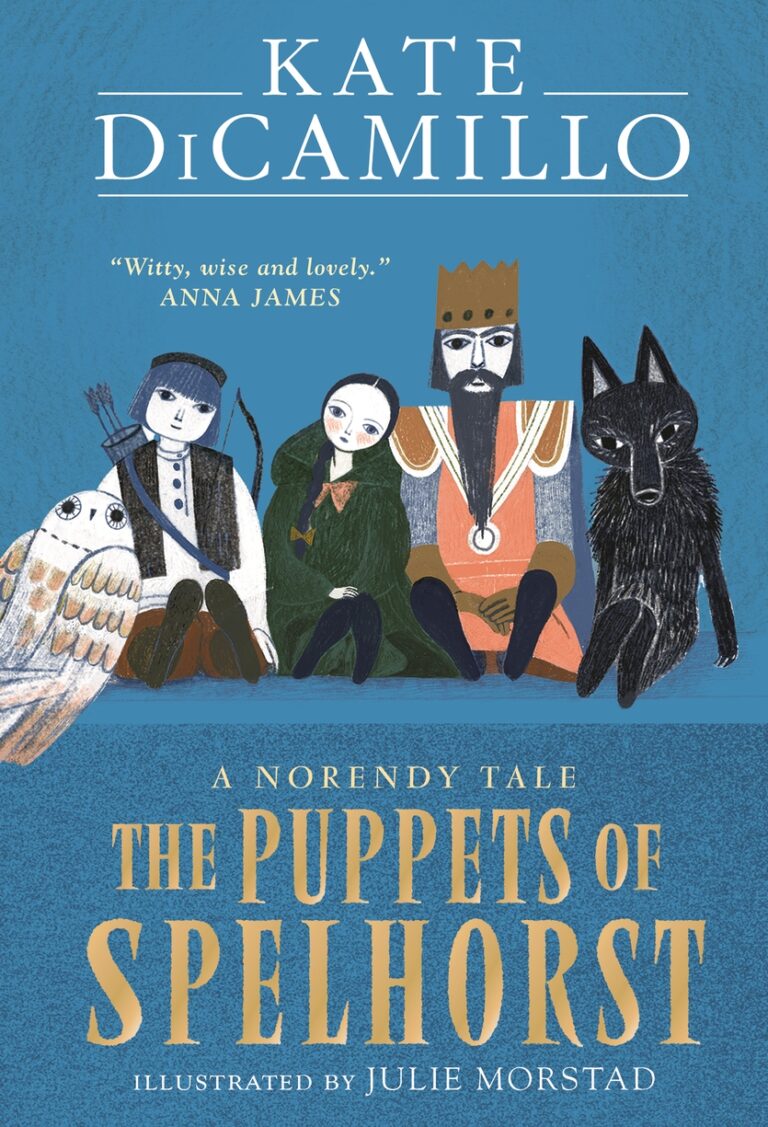
The Puppets of Spelhorst: A Norendy Tale by Kate DiCamillo illustrated by Julie Morstad


At its heart this is a story about the serendipity of life. It is also a quietly understated love story (and you know I adore those). And a story about the fulfilment of hopes and dreams. 

Five puppets languish in a toy store. There is an owl made from real feathers. A young girl with striking violet eyes. A boy with a bow and arrow set. A King who is wearing a crown. And a wolf with very sharp teeth. By chance, a lonely old sea Captain sees the puppets in the window of a toy store. He has no reason to buy this set of toys but the young girl, with her violet eyes, rekindles and old memory of his lost love from long ago. Back at home that night the man named Spelhorst writes a letter, and he places it in his old travelling trunk. This is the final act of his life but it is not the final act for the set of puppets. Their adventures are about to begin - be sure to listen carefully to their hopes and dreams.

The old sailor's trunk is sold and eventually ends up in a home with two young girls. The older girl, Emma, knows these puppets should be part of a play. She finds and reads the letter, but we still have no idea what it says. At this point the fate of those five very different puppets is in the balance. The owl is mistaken for a feather duster and he ends up in a cleaning bucket. The younger sister, as is the way with very young children, takes the boy and the wolf. Her treatment of the wolf made me gasp. And we watch as the boy, in a way I won't explain here, ends up in the top branches of a tree. 

Finally, we come to the night of the play. Emma has written the script and made the scenery. She needs her younger sister Martha and their maid, Jane Twiddum, to help her with the performance. We don't meet the assembled adults but this performance, in three acts, is filled with pathos. It also links very subtly back to that letter written all those weeks ago by the old sailor. 

Betsy Bird (Goodreads): this is the kind of book that’s going to appeal to kids young and old. A contemporary classic with ingrained appeal and the occasional jolt of weirdness to keep things interesting.

A quiet, comforting fable of identity and belonging. Kirkus

Blurb by Kate DiCamilloShut up in a trunk by a taciturn old sea captain with a secret, five friends—a king, a wolf, a girl, a boy, and an owl—bicker, boast, and comfort one another in the dark. Individually, they dream of song and light, freedom and flight, purpose and glory, but they all agree they are part of a larger story, bound each to each by chance, bonded by the heart’s mysteries. When at last their shared fate arrives, landing them on a mantel in a blue room in the home of two little girls, the truth is more astonishing than any of them could have imagined.

Betsy Bird mentions the three songs in this book, and I felt exactly the same way - I do hope someone can set these to music. 

Last week I saw Walker Books Australia had a little 'competition' give away advance copies of The Puppets of Spelborst - you know the kind of thing - first 'x' number of people to respond to this email will be sent an advance copy of Kate DiCamillo's new book. I had very little hope of winning because it was already late in the morning and surely tons of people had seen the email but NO, I was lucky, and I won this book. I picked up the parcel today at 12 noon and I read the whole book in one quick sitting as soon as I arrived home. 

I am calling this book a novella partly because it only has around 150 pages but also because, even though this looks like a slim and therefore junior book, it is not - I would put this book into the hands of readers aged 10+ who will appreciate the way Kate DiCamillo constructs her story and the way she gives each of her puppet and human characters very distinct personalities. There is some violence in this story but also tiny touches of humor and wonderful moments where we witness the fulfilment of dreams.

This book will be released in mid-October here in Australia, so I suggest you pop it onto your shopping list now or place an advance order with your favourite independent bookstore. I guess this will be the first book in a series because the publisher webpage says this is Book One in the Norendy Tale series. And I found more detail on Kate DiCamillo's web page: A beloved author of modern classics draws on her most moving themes with humor, heart, and wisdom in the first of the Norendy Tales, a projected trio of novellas linked by place and mood, each illustrated in black and white by a different virtuoso illustrator.

Here is a PBS interview with Kate DiCamillo. And even more importantly please take a little time to read this New Yorker profile piece from September this year. 

The reporter says uses these words when talking about The Puppets of Spelhorst: 'Joy and Despair' 'Truth Wonder and Sorrow'.

And here is a quote by Kate from the interview:

"One of the great things about being able to tell stories is that I can find a way to make sense out of what happened to me as a kid. And maybe help another kid feel safe and less alone."

Kate DiCamillo dedicates this book to her friend Ann Patchett.  Read what Ann Patchett says about Kate DiCamillo and her books here

My copy of The Puppets of Spelhorst is a paperback ARC but I think the real copy will be a special edition hardcover [9781529512854].  I do like the black and white pencil illustrations by Julie Morstad (I love her work) but it would be even more thrilling to see them in colour. 

This book made me think of these picture books (but they are far simpler stories).


I am a huge fan of Kate DiCamillo. I have read and blogged so many of her books and I was utterly thrilled when I heard her speak twice in Sydney, Australia at our Sydney Writers Festival. If I hadn't been so badly hampered by deep shyness, I would have loved to have talked to her - maybe I can do that one day.


These are some other novellas I have read and enjoyed which would be good to put into the hands of readers who enjoy this story form:


Saturday, December 31, 2022

Glowrushes by Roberto Piumini translated by Leah Janeczko


An entire generation of Italians was raised with his stories and has grown up to read them to their own children. But if you’re from an English-speaking country, chances are you’ve never heard of this award-winning author. World Kid Lit

Madurer is the son of a great lord, with untold wealth, but he is also the victim of a mysterious disease that means he cannot be exposed to sunlight or fresh air. He is confined to three windowless rooms inside a palace, but his doting father summons a famous artist to cover the walls of the rooms with paintings showing the world his son cannot experience for real. As the painter works on his murals, his relationship with the boy begins to deepen until they forge a firm friendship. How can he show this child the beauty of the world with only his paintbrush to work with? Glowrushes is a heartbreakingly beautiful classic of Italian children’s literature, published here in English for the first time. Pushkin Press

This is a big call but this might be my book of the year and by coincidence it is the last day of the year! Philip Pullman has a quote on the wrapper on my book which is perfect:

"I don't think I have read anything like this before - a tale of life, death, love and beauty that by the storyteller's art makes those things true, fresh, real and important. I hope this unforgettable story finds all the readers it deserves."

Thanks to Pushkin Press this book will find lots of readers because they have taken this famous Italian book from 1987 and given us an English translation in 2022. I don't speak Italian but this book does feel very authentic.

“Stralisco” is a strange word, which is not found in the dictionary: it is part of a game between Madurer – a child – and Sakumat – a painter. Madurer is ill and must always be locked up in the dark. Sakumat has the task of showing him the world through his paintings. Their relationship turns into a story of total friendship that unites a child, a man and – in the background – a father, in a very intense adventure. “Lo Stralisco” is a fable about the possible happiness of those who fully accept to look at the world through the eyes of poetry and signs of art. A tale for kids that even the adult public has been able to appreciate. UTE Korner

It is interesting that it has taken so long to produce a version of this story in English because it has already been translated into other languages:

  • Netherlands- dutch language (Querido, Amsterdam 1993)
  • France- french language (Hachette, Parigi 1992)
  • Spain- castillan and catalan language (Edebé, Barcellona 1991)
  • Germany- german language (Hanser, Monaco-Vienna)
  • Japan- japanese language (Komine Shoren, Tokio)

This is a mature, deeply poignant and beautifully drawn book of love, wonder and life. We recommend this title as a thoughtful gift, and then, a wonderful story to read and know together. Book Wagon

I highly recommend this wonderful book to share with a reader aged 10+. It would be better to share this book rather than just hand it to a reader because it it so very different and there are sure to be so many important issues to talk about as you read. 

Opening sentences: "In the Turkish city of Malatya lived a painter named Sakumat, who was neither young nor even old. He was the age at which wise men know how to be their own friend without risking their friendship with others."

About the boy Madurer: "He suffers from a strange illness: every trace of sunshine and dust is harmful to him: his eyes swell, he grows short of breath, a rash and even sores form on his skin. He cannot go outdoors, and run and play in the palace gardens as my servant's children do. Furthermore, he cannot live in a room like this, with a window that lets the mountain air and sunlight enter freely and abundantly. All the doctors in Turkey who boast science and knowledge have visited this palace ... They all strongly recommend Madurer live in the most sheltered, innermost area of the palace. He can only breathe air filtered through layers of damp gauze ... and so it has been for over five years."

The task: "I would like my son's rooms to be decorated with pictures and colours."

What happens: Sakumat and Madurer work together and create an enormous mural of mountains, fields, the ocean and memorable characters and "soon there is a fabulous world on the walls, a colourful, shifting landscape people by shepherds and lover, criss-crossed by armies and pirate ships. ... Can he show this child the richness and beauty of the world and of life itself with nothing but paints and brushes?" (jacket blurb)

The title: Glowrushes come from the artist's imagination with additional idea from Madurer himself. "This is a plant I have never heard of ... it's a sort of firefly plant ... on clear nights it lights up ... the boy sat up in bed. All around him, in the darkness, hundreds of slender wisps glowed with a golden light. Bending this way and that, they shone throughout the dark meadow and seemed to sway in the wind."

Here are three Italian covers for this book with the title Lo Stralisco:


Roberto Pumini was nominated for the Hans Christian Andersen Award (IBBY) in 2020. Here are some of his books:


The Hans Christian Andersen dossier talks about Glowrushes (the Italian edition) "Sakumat is a painter, and he’s called to do a delicate job: a very rich man’ son has a serious illness that forced him to live inside a room, without ever seeing the light of the sun. The painter will have to paint him some landscapes to make him know the world and distract him. And then, maybe, won’t a contact so unbridled and continuous with creativity and imagination save him from death? The novel doesn’t answer these questions in a negative way, it demolishes them."