Tuesday, March 11, 2025

Don't feed the Bear by Kathleen Doherty illustrated by Chip Wass


The setting here is a national park. Campers are having issues with the local bears who eat any food that they leave out on picnic tables - silly tourists! 


Time for action by the ranger. He erects a sign - DON'T FEED THE BEAR. I guess he did not realise that 1. Bears can read and 2. Bears can write.

Bear retaliates with his own sign - DON'T FEED THE RANGER.

And so the war of words begins. Bear purchases some new merchandise - a tshirt that reads "I am not a bear" and a matching hat "not a bear". The Ranger is not fooled so he adds a footnote to his sign DON'T FEED THE BEAR (no matter what he says).

There is power in that word don't - what happens if you cross it out? FEED THE RANGER, FEED THE BEAR (no matter what). Bear consults his dictionary and adds to his sign feed the ranger rotten eggs and slimy spinach. Of course the Ranger just makes more signs - hey you! Go ahead feed the bear wormy apples and moldy muffins.

None of this is working. Is there a different way to approach this problem. The solution will surprise and delight you. Oh and then you will want to make some smores - marshmallows and chocolate between graham crackers. Here is a recipe to use in a kitchen if you don't have a handy camp fire.


Here is the website for Kathleen Doherty. I am happy to see this book from 2018 is still available and the hard cover edition is a really good price. And here is the even cheaper paperback.

Chip Wass is an award-winning artist who designs characters and illustrations for Disney, Cartoon Network, The New York Times, ESPN, and Wendy’s. His previous books include Monster Knows Patterns, and Monster Knows Numbers (Picture Window Books).


Monday, March 10, 2025

Shaun Tan Limited Edition print of The Story Furnace for sale


Limited edition prints are available to purchase
The Story Furnace by Shaun Tan: Numbers 37, 47, 48, 49, 57, 58 and 59.


Are you looking for a special gift for a school library, a teacher, a Teacher-Librarian, an art collector - this could be the piece for you! 

This print could also be a feature piece for your 2025 Book Week display and the slogan:
 
BOOK AN ADVENTURE! 


ACT QUICKLY - this auction ends soon.


I am sure you are familiar with books by Shaun Tan. He was a previous winner of the Astrid Lindgren Memorial Award along with heaps of other book awards here in Australia and beyond.


IBBY Australia was formed in 1966 and is one of 80+ National sections of the International Board on Books for Young People (IBBY). IBBY is a non-profit organization which helps to build bridges to international understanding through children’s books. 

IBBY Australia submits authors and illustrators and their work for several IBBY administered international awards, including:

• The Hans Christian Andersen Award

• IBBY Honour Book List

• The Silent Books collection (Wordless Books)

• The Outstanding Books for Young People with Disabilities list

IBBY Australia pays an Annual International Membership fee which supports the work of IBBY International. Funds raised from our March 2025 auction will assist us to pay our 2025 fees.

When you click the auction link you will also see a wonderful artwork by Bob Graham! We have the original of this and only ONE limited edition print. 

Later in the year we will also hold our mini masterpiece art auction - here are some pieces from 2023. Please note these were all sold at our first art auction:


Gabriel Evans


Nicky Johnston


Lucia Masciullo


Song of the River by Joy Cowley illustrated by Kimberly Andrews


Publisher blurb: In this resonant story from Joy Cowley, Cam the mountain boy follows the river from its trickling source in the snow all the way to the sea. The river leads him through forest, farms and towns to the salty wind of the sea. The dramatic landscapes are packed with detail to discover in the world of the river.

Cam lives in the mountains with his grandfather. He is curious and asks when can they see the sea. Cam sees a trickle of water and hears a voice calling:

"Come with me. Come with me. I will take you to the sea."

Cam follows the trickle and it leads to a creek then a stream and then the stream becomes a river flowing beside farm lands and leading to the port where Cam finally sees a beach and the sea.

"It was wild and beautiful ... and it went on forever."

These lines reminded me of the words by Margaret Mahy (also from New Zealand) from her book The Man whose Mother was a Pirate.

“The little man could only stare. He hadn’t dreamed of the BIGNESS of the sea. He hadn’t dreamed of the blueness of it. He hadn’t thought it would roll like kettledrums, and swish itself on to the beach. He opened his mouth and the drift and the dream of it, the weave and the wave of it, the fume and foam of it never left him again. At his feet the sea stroked the sand with soft little paws. Farther out, the great, graceful breakers moved like kings into court, trailing the peacock-patterned sea behind them.”

This book jumped off the library shelf for two, or maybe three reasons. Firstly I really like the cover and so I expected to like the illustrations. I have put two covers here - one is the hardcover and the other the more affordable paperback. Secondly, I recognised the name Joy Cowley (I recently talked about her new book Good Night Good Beach) and thirdly the library I visit each week has added Sustainable Development Goal stickers to the covers of their books and this one had Goal 6 - Clean water and Sanitation. This link will take you to my post about this exceptional resource created by my friend from Kinderbookswitheverything. And this second link will take you to Goal 6.


Check out this Pinterest of other books you could use to explore this goal

Song of the River is a book you should add to your school library collection. Why? It has lyrical language and a story that makes geography accessible (notice the maps on the end papers) and as I mentioned the illustrations are very appealing. Take a look at these phrases:

The water splashed and sand in the voice of snow.
The creek laughed down the mountainside and chattered over stones.
The river sang in the voice of green and gold frogs.
The river drank other rivers ...


Companion books:


Sunday, March 9, 2025

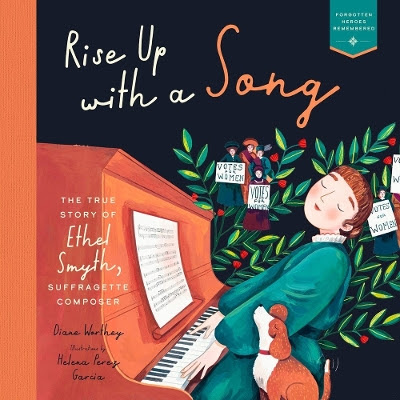
Rise up with a Song by Diane Worthey illustrated by Helena Perez Garcia

The subtitle for this book is: The true story of Ethel Smyth, Suffragette and Composer

From a young age Ethel Smyth loved music. She was a forthright girl, brave and daring. When she was twelve the family employed a new governess - a graduate of the Leipzig Music Conservatory. 

"From that moment, Ethel's desire burned. She spent hours each day writing music to accompany her favourite poems."

It seemed certain that Ethel will follow a career path into music but her father said NO. It took her five years to convince him to let her attend the Leipzig Conservatory in Germany. 

"People said she wouldn't succeed as a composer because she was a woman." 

This meant she had to publish her music with only her initials - E. Smyth. She composed operas, symphonies, and choral works and yes, they were performed. At first no one knew this music came from a woman but then it became popular and she no longer had to pretend to be a man. Of course, there were still some orchestras who would not perform music by a woman especially back in England.

In 1910 other women were also demanding to be noticed - the suffragettes. Ethel joined the movement and followed the creed of Emeline Pankhurst - deeds not words. She wrote music for the protesters to use as a battle cry. Ethel Smyth was becoming famous. 


Perhaps if she did something illegal and went to jail their cause would gain attention. Ethel hurled a rock straight into the window of a cabinet minister. (This is the opening scene from the BBC television series I mention later in this post). She served two months in Holloway prison. While in prison she went on hunger strike. 

Thomas Beecham visited the composer in Holloway Prison in 1912 and found her conducting her fellow inmates with a toothbrush. “I arrived in the main courtyard of the prison to find the noble company of martyrs marching round it and singing lustily their war-chant while the composer, beaming approbation from an overlooking upper window, beat time in almost Bacchic frenzy with a toothbrush”.

Ethel Smyth was born one hundred years before me. She lived until 1944 and was able to vote in eight general elections. I wonder if you have ever heard of her?


In spite of challenging the government through her activism, and her groundbreaking, unconventional life, Dame Ethel Smyth was knighted as a Commander of the British Empire in 1922. She became the first woman to be granted the damehood for her contributions to composition and publication. London Museum

Further reading:

Rise up with a Song is published by the wonderfully named Bushel and Peck. On the final pages there is a timeline of her life; a selected list of her music; and some further reading. See inside this book here. In Australia this book is distributed by NewSouth Books. 

Publisher blurb: In 1867 England, a girl learned to be proper and speak when spoken to. But one girl marched to a different beat. Ethel Smyth climbed fences, explored graveyards, and yearned to become a famous composer at a time when only men could publish their music. But become a composer she did, first signing her music as E. Smyth so people couldn't guess her gender, then eventually writing openly as a woman (but still sometimes not getting paid!). Ethel had had enough. She joined the suffragette movement, marching in the streets and fighting for the right to vote. She even composed the famous "March of the Women" battle cry—and directed it from her cell window with a toothbrush when she was put into prison.


The music to her suffragette anthem - The March of the Women - is presented on the end papers of Rise up with a Song.


Verse 1 
Shout, shout, up with your song! 
Cry with the wind, for the dawn is breaking; 
March, march, swing you along, 
Wide blows our banner, and hope is waking. 
Song with its story, dreams with their glory 
Lo! they call, and glad is their word! 
Loud and louder it swells, 
Thunder of freedom, the voice of the Lord! 

Verse 2 
Long, long—we in the past 
Cowered in dread from the light of heaven, 
Strong, strong—stand we at last, 
Fearless in faith and with sight new given. 
Strength with its beauty, Life with its duty, 
(Hear the voice, oh hear and obey!) 
These, these—beckon us on! 
Open your eyes to the blaze of day. 

Verse 3 
Comrades—ye who have dared 
First in the battle to strive and sorrow! 
Scorned, spurned—nought have ye cared, 
Raising your eyes to a wider morrow, 
Ways that are weary, days that are dreary, 
Toil and pain by faith ye have borne; 
Hail, hail—victors ye stand, 
Wearing the wreath that the brave have worn! 

Verse 4 
Life, strife—those two are one, 
Naught can ye win but by faith and daring. 
On, on—that ye have done 
But for the work of today preparing. 
Firm in reliance, laugh a defiance, 
(Laugh in hope, for sure is the end) 
March, march—many as one, 
Shoulder to shoulder and friend to friend.

Helena Perez Garcia is the illustrator of these books:


I first heard about Ethel Smyth on the 1990s BBC television series called A Skirt Through History. There were six episodes and the stories of Ethel Smyth and another suffragette Sarah Benett were told in the episode entitled The Wreckers which is the name of an opera composed by Ethel Smyth. I think you may be able to find this program on Amazon Prime.


I did once have a VHS video of this episode and I regularly used it with my Grade 6 classes in the library as a part of their unit of work on democracy and voting and suffragettes. Sarah Benett is not part of this book but a few years ago I travelled to Lyme Regis because her diary, which forms the basis of much of this show, was found in the Lyme Regis museum. Unfortunately no one there knew anything about this and my email to the museum curator yielded no answer. 

Here's a summary of this program: "The fight for women's voting rights is told through the writings of two turn-of-the-century British suffragettes - Ethel Smyth and Sarah Benett. Composer and writer Smyth comments on her libertarian life, and her promotion of women's rights through her highly praised opera, The Wreckers. Based on the 1910 window-breaking campaign launched by the Suffragette movement to further their cause, the opera is her most famous work. Also quoting from Benett's diaries, an actor provides a first-person account of the campaign and the hardships suffered by jailed Suffragettes, who were often beaten, raped, and subjected to psychological torture."

The National Portrait Gallery in London have several paintings (including a pencil sketch by John Singer Sargent) and many photographs of Ethel Smyth. Here is a her statue:


Statue in Woking UK


South with the Seabirds by Jess McGeachin

The subtitle of this book says: Follow four remarkable scientists to the edge of the world.

By being one of the first female scientists to join an Antarctic research trip, fearlessly exploring the globe, actively striving to conserve wildlife and leading by example Mary Gillham became an inspiration to female scientists helping to normalise the sight of women in a traditionally male-dominated field.

In this book we meet four scientists. The year is 1959 and that is very significant because only men are considered able to do research in Antartica. The four women we meet here are Mary Gillham from the UK; and Isobel Bennett, Hope Macpherson and Susan Ingham from Australia. Hope and Isobel are marine biologists who plan to study the animals in the rock pools on the shores of Macquarie Island. Mary has been studying birds, animals and plants in a variety of environments from the arid desert to rocky islands. She has a plan to study the seabirds and unique plants and to report on the damage caused by introduced rabbits. Susan wants to check on the seals to make sure their populations are recovering now that hunting is banned. And all four scientists are fascinated by the variety of penguins - Royal, King, Gentoo and the Southern Rockhopper. 


Image Source Antartcia.gov.au


The whole expedition was just 15 days. You can read more and this expedition and about Mary Gillham (1921-2013) and see photos and newspaper articles here. The end papers in South with the Seabirds show four places on Macquarie Island that celebrate the achievements of these women scientists. This book also has a useful timeline and a brief biography of each of the four women. I was thrilled to read that Mary Gillham achieved her PhD. 

Some facts about Macquarie Island:

  • Macquarie Island is located halfway between Tasmania and Antarctica and a station was established on the “green sponge” in 1948. The Island was used as a half way point to establish the first radio link between Australia and Antarctica during Sir Douglas Mawson’s 1911 expedition.
  • Throughout the year, the Macquarie Island teems with vast congregations of wildlife. Where the nutrient rich waters of the Southern Ocean meet warmer northern waters, rich feeding grounds are created and make the island an ideal haven for penguins, seals and seabirds to live and breed.
  • Macquarie Island was declared a wildlife sanctuary in 1933. In 1997, World Heritage status was granted due to its outstanding geological and natural significance.
  • Rabbits, rats and mice, brought to the island over nearly 200 years of visitation and occupation were finally eradicated in 2014, after a 7-year, eradication program. With grazing pressures removed, the island is returning to its former lush, green glory.
In my former school library our Grade 6 students completed a unit of work on Antartica. This book would be a perfect resource. Using this book you could also explore women in Antarctica - scientists, explorers and as people working in the various stations. The publisher webpage has a link to a set of teaching notes to use with South with the Seabirds. 

Here are some websites to explore:


When you introduce the topic of women in science you could also talk about Beatrix Potter. The children are sure to be familiar with her characters like Peter Rabbit and other animals characters who appear in her small books, but Beatrix Potter was also an amazing scientist especially in the area of mycoloy. I think your students will be amazed to learn that as a woman in 1897 she was not permitted to present her research to London’s Linnaean Society, the bastion of Victorian botany, which was exclusively male and barred women from membership, denied them access to the research library, and wouldn’t even allow them to attend the presentations of scientific papers.

We are so lucky to have a talent like Jess McGeachin producing books here in Australia.


South with the Seabirds is a CBCA 2025 Eve Pownall (Non Fiction) Notable title. I am very hopeful it will be one of the six short listed titles which will be announced at the end of March. 


The 2025 CBCA Book of the Year Awards Eve Pownall Award Notables are…

  • All About the Brain by Gabriel Dabscheck (Berbay)
  • Always Was, Always Will Be by Aunty Fay Muir & Sue Lawson (Magabala Books)
  • Anti-Racism Kit by Sabina Patawaran & Jinyoung Kim, illustrated by Emma Ismawi (Hardie Grant Children’s Publishing)
  • Australia’s Baby Animals by Jess Racklyeft (Affirm Press)
  • Before the Mountain had a Name by Fiona Levings (Forty South Publishing)
  • Come Together Again by Isaiah Firebrace, illustrated by Jaelyn Biumaiwai (Hardie Grant Explore)
  • Design & Building on Country by Alison Page & Paul Memmott, illustrated by Blak Douglas (Thames & Hudson Australia)
  • Extreme Animal Facts by Jennifer Cossins (Lothian Children’s Books)
  • Flora: Australia’s Most Curious Plants by Tania McCartney (NLA Publishing)
  • Follow Your Gut by Ailsa Wild & Lisa Stinson, with Briony Barr & Gregory Crocetti, illustrated by Ben Hutchings (Scribe Publications)
  • I am a Magpie, I am a Currawong by Bridget Farmer (Black Cockatoo Books)
  • The Illustrated Encyclopaedia of Extinct Animals by Sami Bayly, illustrated by Sami Bayly (Lothian Children’s Books)
  • Into the Ice: Reflections on Antarctica by Alison Lester & Coral Tulloch (A&U Books for Children and Young Adults)
  • Making the Shrine: Stories From Victoria’s War Memorial by Laura J Carroll (The Crossley Press)
  • Now for the Good News by Planet Ark Environmental Foundation, illustrated by Sarah Wiecek (Penguin Random House Australia)
  • Plantabulous! More A to Z of Australian Plants by Catherine Clowes, illustrated by Rachel Gyan (CSIRO Publishing)
  • Seed to Sky: Life in the Daintree by Pamela Freeman, illustrated by Liz Anelli (Walker Books Australia)
  • Sensational Australian Animals by Stephanie Owen Reeder, illustrated by Cher Hart (CSIRO Publishing)
  • South With the Seabirds by Jess McGeachin (A&U Books for Children and Young Adults)
  • Sunny Finds His Song by Catherine Storey & Penny Watson, illustrated by Sarah Matsuda (Wet Season Books)
  • Too Many Tigers by Monica Reeve (Forty South Publishing, Tasmania)
  • Unreal by Kate Simpson, illustrated by Leila Rudge (A&U Books for Children and Young Adults)
  • Walking the Rock Country in Kakadu by Diane Lucas & Ben Tyler, illustrated by Emma Long (A&U Books for Children and Young Adults)
  • Wedge-tailed Eagle by Claire Saxby, illustrated by Christina Booth (Walker Books Australia)
  • When the World Was Soft by Juluwarlu Group Aboriginal Corporation, illustrated by Alex Mankiewicz (A&U Books for Children and Young Adults)


Saturday, March 8, 2025

Two Turtles by Kiah Thomas illustrated by Jack A Minton


Terrence and Frank are serious rivals. Everything is a competition. If you have siblings you might relate to this. 

"Who has the shiniest shell ... Who can walk the slowest ... Who is the best at pretending to be a shark?"

Then Frank falls off the cliff or perhaps he rolls off - is this an accident? - he cannot bear to lose so he turns this mishap into a competition too and calls out to Terrence 'Bet I can beat you to the bottom'. 

Naturally Frank takes up the challenge and he also jumps off the cliff. Luckily (or perhaps it could be a disaster) this is a very very high cliff. This means there is time to think. About halfway they both realise this could end very badly. At this point you, the reader, are invited to offer some help.

Both turtles have lots of things inside their shells. There are things they have stowed that can could save them but ... you and your young audience need to shout:

HEY, TERRANCE AND FRANK! JUST WORK TOGETHER!

What did they have in their shells? Do they land safely? And most important of all did they learn a life lesson about cooperation (not competition)?

Two Turtles is listed on TWO CBCA 2025 Notables lists - Picture Book of the Year and the Early Childhood list so I thought it must be an amazing book - sorry but I was slightly disappointed. First off I disagree that this is a book for very young readers aged 0-6. 

I made similar comments about Jetty Jumping (here are the teachers notes) and the inclusion of risk-taking behaviours for an audience of very young children. Jetty Jumping is a beautifully illustrated book and it tells a special story but I worried about it being listed for very young children. 

Secondly, Two Turtles is overtly didactic with its lesson about the importance of cooperation, but the ending shows the two turtles are not going to change that that their propensity to see every aspect of their relationship as a competition and it seems their rivalry will continue.

I do like:

  • the way this book 'breaks the fourth wall'
  • the expressive faces on the two turtles (and the bird)
  • the humour - packing a toaster
  • the wise little bird watching these silly turtles - you could write a whole story from his/her perspective
  • the wordless page
  • and there is room here to read other books such as The Hare and the Tortoise (text reference: who can walk the slowest); and The Great White Man-eating Shark by Margaret Mahy (text reference: who is best at pretending to be a shark). 
  • The story structure is interesting moving from the present back to the past and then ending where the story started.

I'm not such a fan of:

  • Repeated digital illustrations (you can see inside this book here)
  • The sudden arrival of extra birds on the second last page - where did they come from?
  • Two pages of black showing the side of the tall cliff
  • The patterned end papers - do they relate to the story or are they decorative?
  • I'm not sure how the four pigs fit into the narrative and also there is a puzzling wire frame around the tree stump where the bird is trying to catch a worm
  • There are tiny butterfly decorations on some pages - are these necessary?
The Kids' Book Reviewer totally disagrees with me. 
The illustrations are stunners, with a gorgeous green and brown palette throughout and the funkiest of animal pals. A birdy spectator features on the pages, expressing its own views about the juvenile turtles with the most entertaining facial expressions. ... Two Turtles is a story for everyone. It’s a story about all of us. I highly recommend you grab a copy. It’s an award winner for sure!

What Book Next.com say: But instead of this becoming a tale of a terrible tragedy, readers will laugh out loud at the antics of two rival turtles. ... Entertaining to the last possible moment!  

Other reviewers liken Two Turtles to books by Jon Klassen such as This is not my Hat. Some other (better) books about rivalry for readers aged 6+ are:


I previously read and enjoyed a middle grade novel by Kiah Thomas - The Callers.


The Callers (five stars from me)


Jake A Minton entered this book in the CBCA New Illustrator award 2023. It didn't win but I was one of the judges and we all agreed this book had very special illustrations. 


Summer Birds by Margarita Engle illustrated by Julie Paschkis


It is International Women's Day - time to celebrate women in Science. I often think about this book Summer Birds and then I searched my blog the other day and realised I hadn't actually talked about it here. Unfortunately, Summer Birds was published in 2010 so you may have to hunt out a copy in a library.

Reading this book several years ago was a revelation. People used to think butterflies came out of the mud in the summer - like magic. Maria Merian, from a very young age, was a curious girl. She collected butterflies and caterpillars but she had to do this in secret because in the 1650s she could have been accused of witchcraft.

Maria observed that caterpillars come from eggs. These are eggs laid by summer birds (butterflies). Caterpillars eat leaves and grow bigger and bigger. Eventually the caterpillars spin cocoons. Then comes the complex part. Inside the cocoon, while they rest, the caterpillars turn into butterflies and then they come out of their cocoon ready to fly and sip nectar. Maria also noticed a change like this with frogs and tadpoles. 

"When people understand the life cycles of creatures that change forms, they will stop calling small animals evil. They will learn, as I have, by seeing a wingless caterpillar turn into a flying summer bird."


About Maria Merian (1647 - 1717) born in Frankfurt, Germany died in Amsterdam:

"At the age of thirteen, Maria was well on her way to disproving the ancient theory (that butterflies came from mud). By careful observation she discovered that metamorphosis is natural, not supernatural. There was no witchcraft involved. Beginning with silkworms brought from Asia by a merchant, she watched the slow process of change, recording every detail in her notes and sketches ... Today as a result of Maria Sibylla Merian's careful studies, we know that butterflies, moths, and frogs do not spring from mud."


In 1705 she published Metamorphosis insectorum Surinamensium (“The Metamorphosis of the Insects of Suriname”). Arguably the most important work of her career, it included some 60 engravings illustrating the different stages of development that she had observed in Suriname’s insects. Similar to her caterpillar book, Metamorphosis depicted the insects on and around their host plants and included text describing each stage of development. The book was one of the first illustrated accounts of the natural history of Suriname. Britannica

Read more and see her art here:

Botanical art and artists

British Museum

Natural History Museum

Royal Society video (4 minutes)

The Conversation (Background reading for teachers)

Here is another book about Maria Merian written for children:


Perhaps you have some books from the Little People Big Dreams series in your library. I would love to see a book in this series about Maria Merian. Here are some other women scientists to explore:

Using Summer Birds as a jumping off point I highly recommend the verse novels written by Margarita Engle. AND every library should have one or two books illustrated by Julie Paschkis - her art is incredibly special.


Books illustrated by Julie Paschkis