Showing posts with label Plays. Show all posts

Wednesday, July 8, 2026

Shakespeare in the Orchard by Danielle Binks


"I suppose we'd like to feel human again' ... A small, mean part of him wanted to make fun and mock - a bunch of Germans wanting feel human in the middle of a war that their lot had started, by play-acting death and destruction, ... but then he heard the others murmuring their agreement with Georg's answer, and he swallowed the acid words he was thinking."

The real strength of this story (apart from learning about Internment camps here in Australia, in particular in Victoria) is the way, very gradually, Jack grows in his understanding of humanity. 

This quote comes near the end of the book:

"All those stories we tell and get told, it's to make them less human ... you know that, because you know them. It's not true, it's just easier to be cruel and look away from what we have in common ... It's harder to kill a man if you know him."

It is 1914 and World War I has just begun. At first Jack is swept up in the war propaganda of Germans as the enemy and of course he is so proud of his brother heading away to train as a soldier. Jack is also learning some army skills himself through his replacement teacher Mr Kempster who is a war fanatic and actually a very dangerous man but not as dangerous as one of the horrible soldiers, Lance Corporal Wright, who has been sent to guard the enemy aliens who are now imprisoned in the rural community of Langwarrin on the Mornington Peninsular. 

Jack has joined the cadets and at first he enjoys the training along with his good friend Walter. But then he witnesses several things in his town which cause him to question the idea of 'the enemy'. Meeting the German prisoners who are sent to help in the apple orchard allows Jack to move beyond that word 'enemy' and understand that these are real people who just happened to be born in a different country and who happened to be here in Australia when we decided people from 'over there' were our enemies.

"if he was honest, there was a lot he hadn't told his mother lately - like the conversations he'd found himself having with the prisoners and his odd curiosity about their lives before the war. Not to mention the Maberly's white feathers and his agreeing to pass Lotti's letters onto Georg (her father) ..."

Jack and his mum anxiously wait for letters from Jack's brother Matt. There is a moment of terrible tension in this story when one of the letters arrives but before Jack can read it to his mother (I am guessing she may had have dyslexia) the letter is lost (Chapter 32). The dreadful Lance Corporal Wright has attacked Lottie (daughter of one of the German prisoners) and he has violently bashed Jack's friend Walter. This horrific incident and my worry over that important letter kept me turning the pages hoping that letter would be found - but it wasn't. 

Blurb from the author page: The whole world is at war. In Langwarrin on the Mornington Peninsula, fourteen-year-old Jack Thorning is the best marksman in military cadet training. His brother, Matt, taught him everything he knew, after their father died. But now Matt has joined the war effort, and it’s up to Jack to hold down the home front and help his mother run the family orchard. When a group of ‘enemy aliens’ are sent to Langwarrin to be held prisoner at the Military base, tensions in the town run high. For Jack and his best friend, Walter, the war feels closer than ever. Like the rest of the town, Jack and Walter want nothing to do with the German prisoners. But as the war progresses, the inmates at the camp are put to work doing manual labour on the farms around Langwarrin, including Jack’s family orchard, and Jack begins to see that the prisoners are people, too. What could Jack possibly have in common with the people responsible for keeping his beloved brother at war? And can Shakespeare bring them all together?

Five years ago I talked about another book based on Internment camps here in Australia (Interned by Pamela Rushby) and in that post I used this article to talk about the features of a good historical novel. I am going to repeat them here because I am so happy to say Danielle Binks does all of these things and she does them brilliantly:

1. Have fun with the research but do your homework. 

This should go without saying, but I’ll say it anyway. Borrow some good reference books. Become comfortable with the time period. Try to understand both the larger scope of the period, while examining aspects of daily life. This will help create an authentic backdrop for your novel.

2. Let the characters engage with the historical details. 

This goes along with that “show don’t tell” truism writers are told all the time. Rather than just dumping a bunch of facts on the poor reader, let your characters interact with these details with all these senses. Let them smell the offal dumped onto the cobblestone streets. Let them squint in the fading light of the tallow candles. Let them feel the tingling sensation as the physician places a leech on their bare skin.

3. Allow your characters to question and explore their place in society. 

This will help reveal the larger political, social, cultural context of the time. What were the expectations for women? For sailors? For criminals? How did people from different parts of society interact with one another?


By coincidence as I finished Shakespeare in the Orchard I picked up our Sydney Morning Herald and saw an article by Danielle Binks under the heading Empathy.

“I am an author who writes sad kid’s books, and I maintain that children are a lot stronger than we give them credit for, and their inner universes so much more complex than we acknowledge. I never try to make my readers upset, I just hope they care enough to feel empathy for the characters I’m giving them.” Danielle Binks Sydney Morning Herald 27 June 2026

She goes on to say:

The book is set during World War I and is inspired by the true events of Australia’s home-front war that unfolded in my hometown of Langwarrin. In 1914, the Australian government suspended habeas corpus for the first (but not the last) time, and imprisoned “enemy aliens” of German and Austro-Hungarian descent. I chose to tell the story from the point of view of a 14-year-old boy named Jack, a military cadet whose brother has joined the war effort and who is being fed a jingoistic form of hyper-nationalism, right when the military reserve across the way from his family’s apple orchard opens its doors to German prisoners. It’s a true but shameful tale of Australia’s war history; a moment when our government arguably did the wrong thing, for the right reasons. The book also tells the true story of how those German prisoners staved off boredom and retained their humanity in the face of such adversity: with theatre. When Jack overhears the prisoners practicing Hamlet, he’s shocked and horrified by their humanity – and his curious response to it.

In this Instagram post you can hear Danielle Banks describing her book. Shakespeare in the Orchard was published yesterday - 7th July. Huge thanks to Gleebooks Kids for loaning me the advance reader copy. 

Daneille Binks suggests her book is for ages 10+ but I am going to say it will better appeal to readers aged 12+ firstly because it is long book (300+ pages) of very small print; secondly because the motivations of several of the Anti-German characters such as the teacher Mr Kempster and Lance Corporal Wright are distressing and complex; thirdly because I think readers will appreciate this book if they have some understanding of or have studied the Shakespeare play Hamlet; and finally because the main character, Jack, is aged 14. I did start this book three times but I kept putting it aside. Then I read a review on social media and the reviewer convinced me to start again and stick with this book - she was right. From about chapter 23 (of the 45 chapters) onwards I was able to read in a more sustained way.

It is a thoroughly heart-warming story demonstrating that prejudices and intolerance are so often created by pure ignorance and willful misunderstandings. A particularly resonant episode is the underlining of the most violent, dangerous and intolerant person in the plot – one of the soldiers reputedly safeguarding the community, not one of the prisoners who remain docile albeit dejected – a thoroughly nasty piece of work. Just so Stories

High School history teachers could make really good use of the letters from Matt that are included in this book especially if the topic is the lead up to the Gallipoli campaign. Here is some background reading about internment camps in Australia. And here are some stories/first-hand accounts. Here are more details in an article from The Conversation


Companion books:


Monday, May 11, 2026

Romeo v Juliet by RA Spratt


"Pauline Lee has fractured her spine ... which is very sad for her ... but good news for you. Because now you get to play Juliet! ... You're the understudy ... you'll have to step in and perform."

Selby has not been listening in rehearsals, she has not read the play and she is terrified of any sort of performance. 

"To Selby's mind, nothing about Romeo and Juliet was romantic. She preferred the romance plots on soap operas, where problems didn't involve violent street gangs, controlling parents and interfering church officials. Soap opera characters had real problems - like your identical twin sister turning up and accidentally making your fiancé fall in love with her. ... Shakespeare could have learned a lot from watching The Bold and the Beautiful - mainly to have more fun and less stabbings."

Selby finds herself back in the real scene 

Here is what Selby thinks about Romeo:

"Romeo totally lived up to the hype. He was by every measure really, really good-looking. He radiated wealth and charm and athleticism, but not in an obnoxious way. He had the natural grace of someone who had been physically and financially blessed every day of his life. He made Selby think of an apex predator. He was an apex romantic hero. THE apex romantic hero."

And Juliet:

"She was beautiful. Like an angel. Her skin was flawless, her dark hair cascaded down her shoulders in shining waves and her face was stunning. ... Her expression spoke of sweetness, which made her seem young for her age."

And Selby:

"Jane Austen did nothing her whole life. She sat in drawing rooms. She never went anywhere, she never worked, she never travelled. And she created seven books that are among the most loved novels ever written.' 'Are you planning to write seven great novels?' asked Mrs Karim. 'No, I can't spell or do grammar,' said Selby. I'm just saying don't underestimate the importance of people who sit quietly in the corner doing nothing. Observers are important too."

And plot points of Romeo and Juliet - comments by Selby:

"Selby couldn't believe things were moving so quickly. 'Marriage? How has this escalated to marriage already ... they only met an hour ago ... first look to first kiss to marriage proposal in an hour is ridiculous."

"she is not the sun, the moon or a star. She is a regular girl who just happens to be beautiful. It is unfair to idealise who she is just because he judges her appearance to be ideal. It sets her up for failure. She can't live up to unrealistic worship. She isn't a goddess. She is a girl."

I explained to Rachel at Gleebooks kids that I am not really a fan of timeslip stories but she convinced me that I would really enjoy Romeo v Juliet and she was RIGHT even though yes this is a timeslip story and also it is slightly above my usual focus because I think this book will better suite a Young Adult audience of readers aged 12+ especially IF they are studying the famous play in their high school English class.

There are parts of this clever story that made me laugh out loud. RA Spratt is able to weave in lines from Shakespeare with a cheeky modern commentary from Selby. Her teacher has decided (rightly) that the best way for these modern teenagers to appreciate this famous play is to perform it. Selby has no intention of performing so she signs up to help with the scenery and props. Her teacher tells Selby she must also be the understudy for the main role of Juliet but Selby knows there is no way, no way ever, that Pauline would give up this role. Then Pauline is in an accident which you know from my text quote at the beginning of this post. 

Publisher blurb: Selby does not want to be in the school play. She is much happier behind the scenes painting sets – anything to avoid standing on stage in front of an audience, performing for disinterested classmates and overenthusiastic parents. So Selby did not plan on landing the lead role of Juliet . . . and she certainly never planned to land in Verona and meet Juliet in person. With chaos, wit and R.A. Spratt wisdom, if those who rush stumble and fall, Romeo and Juliet are about to crash-land into a modern-day town!

If you are a high school teacher and Romeo and Juliet is part of your class study, you MUST buy this book and share it with your students. It is simply perfect. And even readers with little or no knowledge of the actual play are sure to enjoy the banter, rapid fire scenes and modern commentary delivered by t the very feisty Selby. 

R.A. Spratt’s creative licence with what she allows Selby to do to the plays is amusing and a lot of fun. It makes Shakespeare engaging, makes it relatable and is a great way to show readers and kids who read this how retellings can work. It’s a clever way to make to plays accessible, and can be used as a good introduction to them. Seeing it play out simply like this helps understand the original, and all with R.A. Spratt’s trademark humour that makes her books shine and garners her lots of fans. The Book Muse

As characters move back and forth between past and present worlds, we laugh out loud when they misconstrue events. However, Selby and her classmates analyse the play with more modern sensibilities including the feminist perspective. Read Plus

Romeo v Juliet follows on from a previous Shakespeare book from RA Spratt:


Here is the Kirkus review - many of the points in this review also apply to Romeo v Juliet

Here are two other timeslips book featuring Shakespeare:


Monday, June 9, 2025

11 Ruby Road 1900 by Charlotte Barkla


Bookseller blurb: It is 1900 and Dorothy and her family have just moved to a new house at 11 Ruby Road. Ruby Road is a busy street, bustling with activity - families and children, noisy carts and animals. The house is close enough to see the city and very different from the rural life Dorothy has known. Best of all it has a secret writing room that only she knows about! Dorothy has big plans for her new neighbourhood - she wants to put on a play and write it herself! But there are other reasons for her family's move to the city and, as Dorothy starts to learn about her new house, she discovers more about the period of time she's growing up in.

I picked up 11 Ruby Road 1900 from a charity book sale for just AUS$2 - this is a little surprising because this is a fairly new book published in 2024. The book that focuses on 1950 will be released in August this year. 

I would have liked a little more detail on historical facts but all in all, a jolly good read for kiddos from around Year 3 upwards. It would certainly be a good read-around-your-topic for history topics focused on this period ...  Just so Stories

Dorothy is bright, driven and rebellious, regularly in trouble at school but only for matters of principle! As the middle child of 6 girls, she looks to her older sisters for social precedents and sees herself as a trailblazer for the little ones. Curious and willing to break tradition, she is a perfect translator for young readers of the morals, values, opportunities and limitations facing young Australians, particularly women, in this era. Storylinks

Here are all three books from the series so far:

Here is the Lamont review of 11 Ruby Road 1900. Read more about Charlotte Barkla here. Walker Books have written some very detailed teachers notes. I am not sure I would use this book as a class novel but if you had a small book club style group (probably of girls) these notes might give you some ideas to discuss. As a character Charlotte annoyed me - she is too selfish and bossy for me. But I did enjoy the way she changed her play to link with the pressing issue of the times - votes for women. You could perhaps read chapter 20 and link this with your study of Australian history. The teachers notes have some useful ideas about this aspect of the story. I also worry about the awful teacher but perhaps her attitude to 'naughty' students is more a reflection of the times. 

The obvious companion text is this famous Australia book My Place.


I also thought of this book where a group of kids are putting on a play:


And this wonderful book by Katrinia Nannestad:


Sunday, December 22, 2024

Ruby the Christmas Donkey by Mirabel Cecil illustrated by Christina Gascoigne


"The little animals were usually fast asleep now, but they could not rest while their old friend Ruby was so unhappy. They decided that since she could not make a warm winter coat for herself, they would make one for her."

This is a deeply poignant story about an old donkey who spends her summers giving rides to children at the beach but now it is winter. It is bitterly cold and usually Ruby and the other donkey named Scarlett are able to grow a warmer coat as they spend winter in a farm paddock but this year Ruby just feels too old to grow her coat. The wild animals are deeply concerned and so they weave Ruby a beautiful coat from various forest materials.

When the neighborhood children come to select donkey for their Nativity play they see Ruby in her magical coat. She looks perfect for the play and so she is led away to be the star of the show with the promise of a happy but not specified happy ending. 

Ruby's friends think her as precious as the gem she's named after in this deft tale of generosity, compassion and love. An aging donkey no longer able to grow a warm winter coat, Ruby faces her last days in icy misery. But the donkey's woodland pals literally give of themselves to weave Ruby a warm, colorful coat. To boot, her newly stylish appearance earns her a starring role in the Christmas pageant. Chipper animals rendered in soft, earth-toned watercolors, brighten the stark snowy landscape. Publisher's Weekly

Here is the hardcover edition:


This book is from 1980 and so it is long out of print. I picked up a copy at a charity book sale in 2019 for just AUS$1. I have seen a new first edition copy of Ruby the Christmas Donkey is for sale for US$65. I haven't been able to find out very much about the illustrator Christina Gascoigne except that she and Mirabel Cecil were neighbors in Norfolk UK. Mirabel Cecil died aged 80 in 2024.  Here is another of their books: 


Here in Australia it is the end of the school year and many school libraries take the opportunity to 'weed' or cull their book collections. Of course, this is necessary, but I would hope that the staff especially the teacher-librarians involved in this process might take the time to read the picture books they think need culling. A tiny insignificant book like this could easily be culled but that should not happen. This is a sweetly emotional story about kindness, empathy and Christmas with soft colour pencil illustrations. I do hope you can find a copy in your local or school library and while it might be too late this year perhaps you can share it next Christmas.


Thursday, September 28, 2023

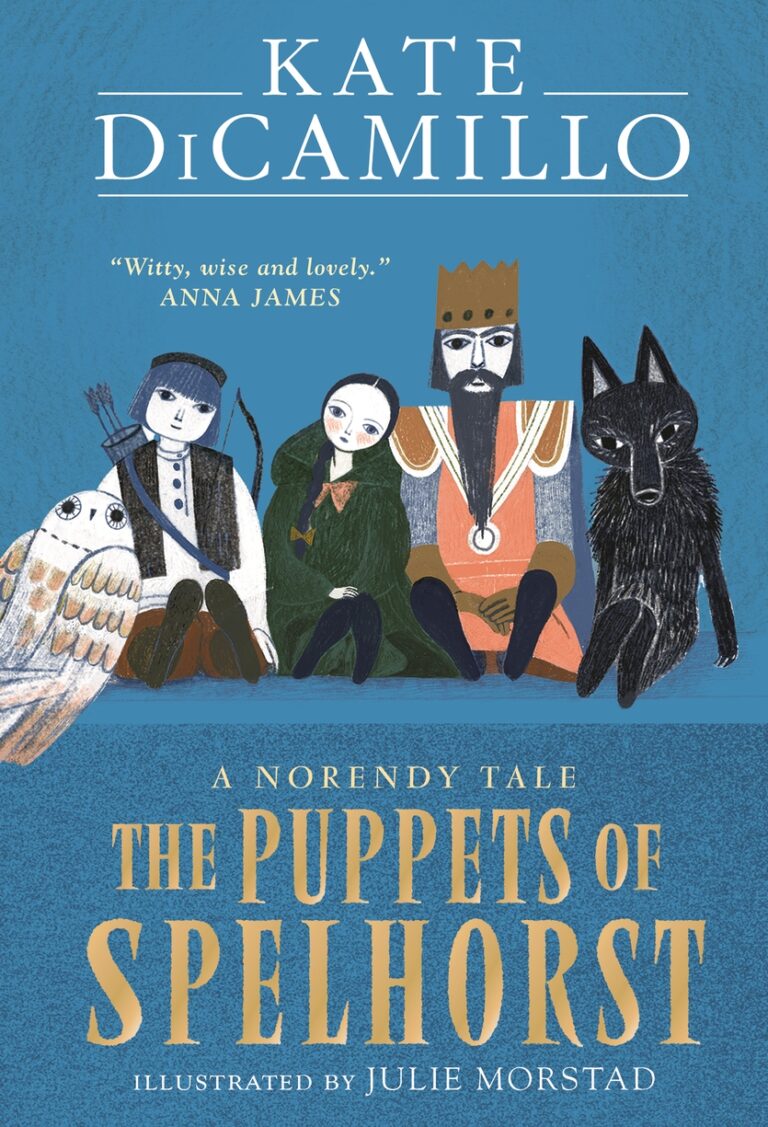
The Puppets of Spelhorst: A Norendy Tale by Kate DiCamillo illustrated by Julie Morstad


At its heart this is a story about the serendipity of life. It is also a quietly understated love story (and you know I adore those). And a story about the fulfilment of hopes and dreams. 

Five puppets languish in a toy store. There is an owl made from real feathers. A young girl with striking violet eyes. A boy with a bow and arrow set. A King who is wearing a crown. And a wolf with very sharp teeth. By chance, a lonely old sea Captain sees the puppets in the window of a toy store. He has no reason to buy this set of toys but the young girl, with her violet eyes, rekindles and old memory of his lost love from long ago. Back at home that night the man named Spelhorst writes a letter, and he places it in his old travelling trunk. This is the final act of his life but it is not the final act for the set of puppets. Their adventures are about to begin - be sure to listen carefully to their hopes and dreams.

The old sailor's trunk is sold and eventually ends up in a home with two young girls. The older girl, Emma, knows these puppets should be part of a play. She finds and reads the letter, but we still have no idea what it says. At this point the fate of those five very different puppets is in the balance. The owl is mistaken for a feather duster and he ends up in a cleaning bucket. The younger sister, as is the way with very young children, takes the boy and the wolf. Her treatment of the wolf made me gasp. And we watch as the boy, in a way I won't explain here, ends up in the top branches of a tree. 

Finally, we come to the night of the play. Emma has written the script and made the scenery. She needs her younger sister Martha and their maid, Jane Twiddum, to help her with the performance. We don't meet the assembled adults but this performance, in three acts, is filled with pathos. It also links very subtly back to that letter written all those weeks ago by the old sailor. 

Betsy Bird (Goodreads): this is the kind of book that’s going to appeal to kids young and old. A contemporary classic with ingrained appeal and the occasional jolt of weirdness to keep things interesting.

A quiet, comforting fable of identity and belonging. Kirkus

Blurb by Kate DiCamilloShut up in a trunk by a taciturn old sea captain with a secret, five friends—a king, a wolf, a girl, a boy, and an owl—bicker, boast, and comfort one another in the dark. Individually, they dream of song and light, freedom and flight, purpose and glory, but they all agree they are part of a larger story, bound each to each by chance, bonded by the heart’s mysteries. When at last their shared fate arrives, landing them on a mantel in a blue room in the home of two little girls, the truth is more astonishing than any of them could have imagined.

Betsy Bird mentions the three songs in this book, and I felt exactly the same way - I do hope someone can set these to music. 

Last week I saw Walker Books Australia had a little 'competition' give away advance copies of The Puppets of Spelborst - you know the kind of thing - first 'x' number of people to respond to this email will be sent an advance copy of Kate DiCamillo's new book. I had very little hope of winning because it was already late in the morning and surely tons of people had seen the email but NO, I was lucky, and I won this book. I picked up the parcel today at 12 noon and I read the whole book in one quick sitting as soon as I arrived home. 

I am calling this book a novella partly because it only has around 150 pages but also because, even though this looks like a slim and therefore junior book, it is not - I would put this book into the hands of readers aged 10+ who will appreciate the way Kate DiCamillo constructs her story and the way she gives each of her puppet and human characters very distinct personalities. There is some violence in this story but also tiny touches of humor and wonderful moments where we witness the fulfilment of dreams.

This book will be released in mid-October here in Australia, so I suggest you pop it onto your shopping list now or place an advance order with your favourite independent bookstore. I guess this will be the first book in a series because the publisher webpage says this is Book One in the Norendy Tale series. And I found more detail on Kate DiCamillo's web page: A beloved author of modern classics draws on her most moving themes with humor, heart, and wisdom in the first of the Norendy Tales, a projected trio of novellas linked by place and mood, each illustrated in black and white by a different virtuoso illustrator.

Here is a PBS interview with Kate DiCamillo. And even more importantly please take a little time to read this New Yorker profile piece from September this year. 

The reporter says uses these words when talking about The Puppets of Spelhorst: 'Joy and Despair' 'Truth Wonder and Sorrow'.

And here is a quote by Kate from the interview:

"One of the great things about being able to tell stories is that I can find a way to make sense out of what happened to me as a kid. And maybe help another kid feel safe and less alone."

Kate DiCamillo dedicates this book to her friend Ann Patchett.  Read what Ann Patchett says about Kate DiCamillo and her books here

My copy of The Puppets of Spelhorst is a paperback ARC but I think the real copy will be a special edition hardcover [9781529512854].  I do like the black and white pencil illustrations by Julie Morstad (I love her work) but it would be even more thrilling to see them in colour. 

This book made me think of these picture books (but they are far simpler stories).


I am a huge fan of Kate DiCamillo. I have read and blogged so many of her books and I was utterly thrilled when I heard her speak twice in Sydney, Australia at our Sydney Writers Festival. If I hadn't been so badly hampered by deep shyness, I would have loved to have talked to her - maybe I can do that one day.


These are some other novellas I have read and enjoyed which would be good to put into the hands of readers who enjoy this story form:


Saturday, November 28, 2020

Pierre's not There by Ursula Dubosarsky illustrated by Christopher Nielsen


"Lara had always wished she was a dog, and one day, 

just for a short time, she actually became one."


From the first few pages Ursula Dubosarsky had me intrigued. Where were Lara and her mum going for the day? Why were they going there? And most pressing of all -  why is there a the cast list on the first page? I love that the opening of this book is clearly in Sydney starting at our Circular Quay ferry wharf but the story also has a universal feel. Perhaps the ferry is heading to Rose Bay or is this Manly? 

"In front of the wharf was a long, green park with thick grass and tall Norfolk pines with drooping dark-green branches. Beyond the edge of the grass was a smear of beach with white sand, sparkling like glitter."

Lara's mother has come to clean a house. She has clearly been here previously as she knows where to find the hidden key. Lara is on holidays so she has come along too. Standing in the garden, Lara notices a small boy at an upstairs window. How is this possible? The house is supposed to be empty. Lara heads up stairs and she finds a boy - Pierre - and he shows her something very special:

"It was a puppet theatre! Made of wood, painted with curls and columns in faded gold and silver, like a temple from ancient Greece. At the front there were two velvet curtains and behind them a sheet of scenery gleamed in the darkness, snow on top of a mountain."

Pierre needs Lara to help him. He tells Lara his whole family have been eaten by a pack of wolves. His mother has told him, if he is ever alone, he must find his grandmother. Pierre grabs a puppet from his collection and begins to tell a story. He tells Lara to find a puppet too. She reaches into the box without looking and picks up the wolf puppet. 

Lara is transported into the story as a wolf. Pierre is terrified of her but Lara can talk (luckily) and she explains that she is not really a fierce wolf, she is actually just a friendly dog. It is time for the play to really begin and so the text now changes form into a script. Lara and Pierre have a long way to go, there are dangers to overcome and new friends to help them. Pierre must find his grandmother and as a reader we must reach that all important happy ending.

If you've never read a play before you are in for a treat. The really delicious parts I think, that add so much to this format, are all the little stage directions. I didn't ever write plays the way Ursula did as a young child but I did love reading them in one of my first books - The Youngest Child's Ominbus and also in the NSW School Magazine. And later as an adult I did enjoy acting in a few small town amateur theatre productions too. There is something very satisfying about reading a play script - the action just zooms along and before you realise it you have reached the final act.


I think this one would make a great first chapter book or even a story that could be read together over several nights. BookBook Owl

Here is an interview with Ursula by Joy Lawn and a link to a set of teachers notes.

I am going to make one of my predictions and say this book Pierre's not There will be one of the titles on the CBCA 2021 Notable list and I also hope it might make the final six short listed titles too. I think I smiled through the whole story. This book would be a perfect addition to a school library or home collection and teachers could consider buying multiple copies to use with a group of children so they can act out the play! You will probably want to investigate a few fairy tales (Little Red Riding Hood) and also find out more about Punch and Judy shows too. Punch is such a diabolical fellow - boo hiss.

Ursula Dubosarsky is our 2020-2021 Australian Children's Laureate and in this Covid year she has been an amazing ambassador for kids and reading and libraries and Australian books and so much more!


In our NSW School magazine you can find other plays written by Ursula. She also wrote this little Nibble title many years ago about a puppet show:


You should also look for these - just a handful of titles which I loved written by Ursula:

Tales of all Kinds

Leaf Stone Beetle

Jerry


I found some other plays by Ursula Dubosarsky on the NSW School Magazine site:


Sunday, February 26, 2017

Henrietta and the perfect night by Martine Murray


This is the fourth book about Henrietta and it does not disappoint.  Inside Henrietta and the Perfect Night there are five interlinked stories beginning with The Waiting Game - waiting for the new baby to arrive and ending with The Arrival!

"Hello, I'm Henrietta the Great Go-Getter. I'm also a Big Thinker. And right now I'm thinking about my mum getting fat."

Henrietta goes to school for the first time, she makes a new friend, participates in the school play and survives her first sleep over.

There are perfect little illustrations scattered throughout this book and Martine Murray uses different fonts to express the meaning of words.  You can see this idea in the Geronimo Stilton books.

Other series to look for :

  • Judy Moody
  • Violet Mackrel
  • Clementine
  • Daisy Dawson
  • Anna Hibiscus
  • Billie B Brown