Showing posts with label Farming. Show all posts

Wednesday, July 8, 2026

Shakespeare in the Orchard by Danielle Binks


"I suppose we'd like to feel human again' ... A small, mean part of him wanted to make fun and mock - a bunch of Germans wanting feel human in the middle of a war that their lot had started, by play-acting death and destruction, ... but then he heard the others murmuring their agreement with Georg's answer, and he swallowed the acid words he was thinking."

The real strength of this story (apart from learning about Internment camps here in Australia, in particular in Victoria) is the way, very gradually, Jack grows in his understanding of humanity. 

This quote comes near the end of the book:

"All those stories we tell and get told, it's to make them less human ... you know that, because you know them. It's not true, it's just easier to be cruel and look away from what we have in common ... It's harder to kill a man if you know him."

It is 1914 and World War I has just begun. At first Jack is swept up in the war propaganda of Germans as the enemy and of course he is so proud of his brother heading away to train as a soldier. Jack is also learning some army skills himself through his replacement teacher Mr Kempster who is a war fanatic and actually a very dangerous man but not as dangerous as one of the horrible soldiers, Lance Corporal Wright, who has been sent to guard the enemy aliens who are now imprisoned in the rural community of Langwarrin on the Mornington Peninsular. 

Jack has joined the cadets and at first he enjoys the training along with his good friend Walter. But then he witnesses several things in his town which cause him to question the idea of 'the enemy'. Meeting the German prisoners who are sent to help in the apple orchard allows Jack to move beyond that word 'enemy' and understand that these are real people who just happened to be born in a different country and who happened to be here in Australia when we decided people from 'over there' were our enemies.

"if he was honest, there was a lot he hadn't told his mother lately - like the conversations he'd found himself having with the prisoners and his odd curiosity about their lives before the war. Not to mention the Maberly's white feathers and his agreeing to pass Lotti's letters onto Georg (her father) ..."

Jack and his mum anxiously wait for letters from Jack's brother Matt. There is a moment of terrible tension in this story when one of the letters arrives but before Jack can read it to his mother (I am guessing she may had have dyslexia) the letter is lost (Chapter 32). The dreadful Lance Corporal Wright has attacked Lottie (daughter of one of the German prisoners) and he has violently bashed Jack's friend Walter. This horrific incident and my worry over that important letter kept me turning the pages hoping that letter would be found - but it wasn't. 

Blurb from the author page: The whole world is at war. In Langwarrin on the Mornington Peninsula, fourteen-year-old Jack Thorning is the best marksman in military cadet training. His brother, Matt, taught him everything he knew, after their father died. But now Matt has joined the war effort, and it’s up to Jack to hold down the home front and help his mother run the family orchard. When a group of ‘enemy aliens’ are sent to Langwarrin to be held prisoner at the Military base, tensions in the town run high. For Jack and his best friend, Walter, the war feels closer than ever. Like the rest of the town, Jack and Walter want nothing to do with the German prisoners. But as the war progresses, the inmates at the camp are put to work doing manual labour on the farms around Langwarrin, including Jack’s family orchard, and Jack begins to see that the prisoners are people, too. What could Jack possibly have in common with the people responsible for keeping his beloved brother at war? And can Shakespeare bring them all together?

Five years ago I talked about another book based on Internment camps here in Australia (Interned by Pamela Rushby) and in that post I used this article to talk about the features of a good historical novel. I am going to repeat them here because I am so happy to say Danielle Binks does all of these things and she does them brilliantly:

1. Have fun with the research but do your homework. 

This should go without saying, but I’ll say it anyway. Borrow some good reference books. Become comfortable with the time period. Try to understand both the larger scope of the period, while examining aspects of daily life. This will help create an authentic backdrop for your novel.

2. Let the characters engage with the historical details. 

This goes along with that “show don’t tell” truism writers are told all the time. Rather than just dumping a bunch of facts on the poor reader, let your characters interact with these details with all these senses. Let them smell the offal dumped onto the cobblestone streets. Let them squint in the fading light of the tallow candles. Let them feel the tingling sensation as the physician places a leech on their bare skin.

3. Allow your characters to question and explore their place in society. 

This will help reveal the larger political, social, cultural context of the time. What were the expectations for women? For sailors? For criminals? How did people from different parts of society interact with one another?


By coincidence as I finished Shakespeare in the Orchard I picked up our Sydney Morning Herald and saw an article by Danielle Binks under the heading Empathy.

“I am an author who writes sad kid’s books, and I maintain that children are a lot stronger than we give them credit for, and their inner universes so much more complex than we acknowledge. I never try to make my readers upset, I just hope they care enough to feel empathy for the characters I’m giving them.” Danielle Binks Sydney Morning Herald 27 June 2026

She goes on to say:

The book is set during World War I and is inspired by the true events of Australia’s home-front war that unfolded in my hometown of Langwarrin. In 1914, the Australian government suspended habeas corpus for the first (but not the last) time, and imprisoned “enemy aliens” of German and Austro-Hungarian descent. I chose to tell the story from the point of view of a 14-year-old boy named Jack, a military cadet whose brother has joined the war effort and who is being fed a jingoistic form of hyper-nationalism, right when the military reserve across the way from his family’s apple orchard opens its doors to German prisoners. It’s a true but shameful tale of Australia’s war history; a moment when our government arguably did the wrong thing, for the right reasons. The book also tells the true story of how those German prisoners staved off boredom and retained their humanity in the face of such adversity: with theatre. When Jack overhears the prisoners practicing Hamlet, he’s shocked and horrified by their humanity – and his curious response to it.

In this Instagram post you can hear Danielle Banks describing her book. Shakespeare in the Orchard was published yesterday - 7th July. Huge thanks to Gleebooks Kids for loaning me the advance reader copy. 

Daneille Binks suggests her book is for ages 10+ but I am going to say it will better appeal to readers aged 12+ firstly because it is long book (300+ pages) of very small print; secondly because the motivations of several of the Anti-German characters such as the teacher Mr Kempster and Lance Corporal Wright are distressing and complex; thirdly because I think readers will appreciate this book if they have some understanding of or have studied the Shakespeare play Hamlet; and finally because the main character, Jack, is aged 14. I did start this book three times but I kept putting it aside. Then I read a review on social media and the reviewer convinced me to start again and stick with this book - she was right. From about chapter 23 (of the 45 chapters) onwards I was able to read in a more sustained way.

It is a thoroughly heart-warming story demonstrating that prejudices and intolerance are so often created by pure ignorance and willful misunderstandings. A particularly resonant episode is the underlining of the most violent, dangerous and intolerant person in the plot – one of the soldiers reputedly safeguarding the community, not one of the prisoners who remain docile albeit dejected – a thoroughly nasty piece of work. Just so Stories

High School history teachers could make really good use of the letters from Matt that are included in this book especially if the topic is the lead up to the Gallipoli campaign. Here is some background reading about internment camps in Australia. And here are some stories/first-hand accounts. Here are more details in an article from The Conversation


Companion books:


Tuesday, November 19, 2024

Three Strike Summer by Skyler Schrempp


"First the rain stopped falling. Then the wheat stopped growing. Then the dust storms started coming. Then the tractor stopped working, and the jars in the cellar started dwindling, and Pa stopped joking and joshing like the words dried right up in his mouth."

Times are so hard. The have to leave the farm. This is the place where the young child Little Si is buried. Gloria is in such a rage. Everything is so unfair. She picks up a rock and hurls into the window of the bank manager's car!

"Gloria. Mae. Willard. ... I ain't ever been as mad with one of kids as I was today. Never. But I never raised a hand to you, and I'm not about to start. ... I raised you better than to be smashing things up and cussing at your sister and paying no mind whatsoever to your ma, so you knock it right off, hear?"

Gloria is the wild child of the family. She is not afraid to speak up especially about an injustice. One of the biggest of these in her life is that the boys will not take her seriously when she says she wants to play baseball. Gloria knows she is a fine pitcher but those boys won't even give her a chance. 

"She'd been sneaking off whenever they practiced and hanging around the baseball diamond, waiting and hoping they'd give me a chance."

And now they have to leave their farm and Gloria will have to find a new team and start all over again to try to convince these new kids that she sure is a real fine player. What will happen on this new farm in California? The family, and all farm workers, are treated so badly by the farm manager. Picking peaches is hard, hard work. And there are so many rules. Things were bad before but now they seem way worse. At every turn the family debits are rising. But for Gloria there is one glimpse of happiness - she manages to talk her way in the boy's gang and their baseball team and there is a big game lined up with kids on the next farm. Surely, with Gloria on their team, her gang will win. And somehow this will also make things fairer for her folks and for the other workers. All of this will mean breaking the rules and keeping secrets from the adults but Gloria is so determined to win and also to expose the corruption she has witnessed among the farm bosses. 

"When you don't fight for what you deserve, the world just digs its heel into you little bit more. If you don't speak up for yourself, probably no one else will ... "

Three Strike Summer is a punchy, inspiring historical middle grade book about family, baseball, and life on farms during the Great Depression. Featuring a spunky female protagonist who won’t take no for an answer, this book explores a wide range of themes from gender inequality to poor worker compensation and dealing with death and grief. Reading Middle Grade

This is one of those books that I just 'gobbled up'. I read it as an ebook during my recent trip. I love the way Skyler Schrempp describes the door knocking pattern - "a shave and a haircut, two bits". This book will also give readers a wonderful insight into life during the Great Depression and the beginnings of workers unions, worker saftey and workers rights. Listen to an audio sample read by the author. Here is the web page for Skyler Schrempp

I cheered when I read the review by Betsy Bird:

Three Strike Summer? The pun in the name is the name of the game. This here’s a baseball book, loud and proud. You’re fairly sure of the fact when, in Chapter One, Glo uses her golden pitching arm to nail a rock through that car window of the bank man repossessing their house. ... I don’t know it for a fact, but suspect a person wholly unaware of the rules of the game would still get swept up in Schrempp’s storytelling. ... For me, one of the best parts of the book was an almost off-handed comment from Glo’s ma late in the story. At the beginning of the book Glo is furious and baffled by her mother’s willingness to just pick up and leave the family farm without so much as a blink. When at last Glo is able to ask her about it, almost at the end of the book, her ma says honestly, “Aw, Gloria… You couldn’t have paid me a million dollars to keep on living in a house that my baby died in.” Glo’s little brother died, probably because of the Dust Bowl, in that home. It’s so simple and so human and so understandable. Plus, I love children’s books where kids get this sudden clarifying instant where they can see everything adults have to go through and try to hide.

Narrated by Gloria in a conversational tone that brings the setting to life, readers feel her grief, outrage, and gritty determination. Descriptions of the Dust Bowl years and hardscrabble life in the camps are searing, and Gloria matures as she learns about others’ struggles. While she organizes a ballgame, Pa organizes the peach orchard workers to strike for better conditions only to be betrayed. Pa is in danger of being clobbered by police until Gloria and her teammates intervene, illustrating the importance of hope, honor, and team spirit in combating hardship. An informative author’s note explains the historical context, including the reasons behind the all-White communities Gloria inhabits. Kirkus Star review

Here are some text quotes to give you a flavour of this writing:

"I knew that bank man was coming. I knew what he was there for. And I knew what would happen when he was done with us."

"He had taken the bank man outside so we didn't have to hear him beg."

"I wanted to belong somewhere, even if it wasn't Oklahoma. I wanted to be someone people listened to, even if I was loud sometimes and maybe said the wrong thing once in a while. ... And I wanted to play ball for real, not just by myself, knocking old apples out of a tree with a creek tone, or watching everyone else play. I wanted to be on a team."

"I missed her biscuits. I missed her breads. I missed her green beans ... I missed smoky bacon and golden, runny egg yolks. I missed her blackberry jams, dark and sweet enough to keep a smile on your face all night. And fritters fried."

"Anyone congregating in groups at any time of day will be personally escorted off the property. We employ good, decent folks here, not lazy sons of guns, not rabble-rousers, not Reds."

"Meanness is funny like that. The bigger you get the smaller, they have to make you feel."

"I just wat there trying not to see Davey falling again and again. Kicking myself for telling him to go up that ladder in the first place. Downright dumb. Downright selfish."

Companion books:


Wednesday, January 17, 2024

Silver Linings by Katrina Nannestad


Nettie (Lynette) Sweeny lives with her three sisters and her dad on a farm. The year is 1952 and in a few months Princess Elizabeth will be crowned queen and shortly after this she will visit Australia and in particular rural Australia - coming to a town near where Nettie lives. Nettie's mum died in childbirth. Nettie longs for the love of a mother and so it is wonderful to read that when Nettie turns five her father remarries. Alice is a perfect mum to all the girls but especially to young Nettie. I think Alice is my favourite character in this story along with young Nettie of course oh and the wise bus driver. Here are some text quotes about Alice:

"Dinner is filled with happy chatter. Every time Alice puts her knife down, I weave my fingers in and out of hers. Eventually overcome by the thrill of having my own real mother, I slip out of my chair and hang off her neck. I spend the rest of the meal running my knuckles along the pearls on her necklace ... and planting kisses on her cheek."

"Alice gives us one more kiss, which makes the skin on my forehead tingle with happiness ... "

"Mum spends heaps of time sitting on the lounge or in bed because Billy's always hungry and needs a lot of feeding. She uses one arm for holding Billy, so there's always a spare one for wrapping around me and plenty of room for Muriel if she wants to snuggle up too. Which she does."

The Australian vernacular in this story is so endearing and I didn't tire of the sweet 'joke' about babies and storks and Nettie's sweet misunderstandings and earnest little letters sent to the stork asking for a baby. 

I wonder what readers from other places in the world will make of expressions like these:

'whacko the diddly-oh!'
'stone the crows'
chooks (chickens)
'ruddy cold'
'that's a porky' (tall tale or a lie)
crook (unwell)
yarn (a story)
duffer (fool)

This story has terrific descriptions of life in a small rural school. I really enjoyed the scenes where the kids are preparing their Christmas play and also getting ready to meet the young Queen Elizabeth. The importance of supporting neighbours during times of hardship and disasters such as floods is also a theme and there are references to the damage done to the minds of returning soldiers - which we now call PTSD. I think Aunty Edith may have had a Victorian upbringing - she has such strict beliefs about the behaviour of children. She is also attached to lace hankies and the importance of eating peas. There are some truly funny moments when Nettie uses her doll Fancy Nancy to voice her frustrations about Aunty Edith. Fancy Nancy can say all the naughty words that the children might think but they would never dare to say!

You will find a link to some very good teacher's notes here. Katrina Nannestead says: "This story is fiction but inspired by family history."

Publisher blurb: A new heartwarming novel set in 1950s Australia from bestselling author Katrina Nannestad. Nettie Sweeney has a dad, three big sisters, a farm full of cows and a cat called Mittens. But it’s not enough. She longs for a mother. One with a gentle touch and sparkles in her eyes. Instead, she has Aunty Edith with slappy hands, a sharp tongue and the disturbing belief that peas are proper food. When Dad marries Alice, all Nettie’s dreams come true. The Sweeney home overflows with laughter, love and, in time, a baby brother. Billy. The love of Nettie’s life. Then tragedy strikes. The Sweeney family crumbles. Nettie tries to make things right, but has she made everything so much worse?

An emotionally rich narrative with big, complex themes, told in a way that’s irresistibly immersive for middle-grade readers. Nettie is a captivating protagonist with a huge heart. While her naive innocence at the beginning of the book makes her immediately endearing, the resilience and courage she develops over the course of the book’s tragic events will earn her a special forever-place in readers’ hearts. Better Reading

I am adding this book to my list of CBCA (Children's Book Council of Australia) notable and short list predictions. This book will warm your heart, then break your heart and then on the final pages, while the sadness is still there, you will be given a small glimpse of a better future. This book is sure to become a classic in the same way Seven Little Australian's captured our hearts last century.  I recommend this book for readers aged 11+. Note there are some suggestions of domestic violence in the home of their neighbours the Parkes.


Other books by Katrina Nannestad - I have LOVED all of them.


Sunday, August 27, 2023

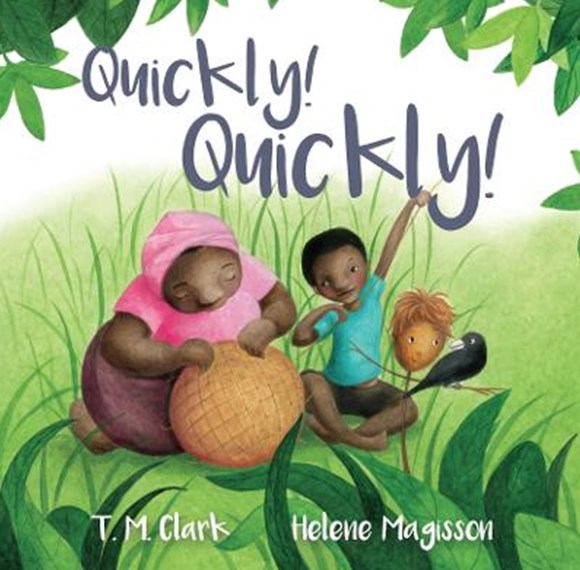
Quickly! Quickly! by TM Clark illustrated by Helene Magisson

Crafty crows camped on the corners of the field.

Monkeys mined for mealworms and munched mangoes.

Bongani beat his drum and shouted, 'Get away from my crops.'


Bongani is not old enough to go to school, but he is old enough to help with planting the crops. He sees crafty crows ready to eat the maize and monkeys munching on his mangoes. Somewhere along the way Bongani has heard the word scarecrow. He thinks if he can catch a crow then he can make a 'scared crow'. His grandmother and mother have been out in the field with Bongani and his grandmother explains a little about scarecrows. But Bongai is sure if a crow sits on the shoulder of a scarecrow the other crows will stay away. 

His grandmother weaves a large round basket and they put some corn inside. She explains: When a crow steps under the basket you have to be fast - quickly quickly - pull the string. But the crow flies away. Then the tables are turned and it is the crow, sitting on the tiny homemade scarecrow (you can see it on the cover), who shouts - get away from my crops. Oh no and now the elephants have arrived. 

This story has a folk tale feel and the alliterative repeated refrain means this text will work really well as a read aloud to young children. Helene Magisson gives her characters warm personalities. I love the rich colours of their clothes. The setting feels like an authentic African village. The twist at the end will make readers smile.  

I love the relationship between Bongani and his grandmother and her gentle patience and encouragement. There are so many details to notice in the illustrations such as the oxen working their land, the bare feet of the grandmother and Bongani, the babies held by their mothers while they work in the fields, the grandmother weaving the basket which they use for the trap and the iconic baobab tree. This book explores themes of family, community and culture.

The author says:

Bongani has grown a little, but has accepted that he is still too small to attend school just yet. But when he has to help protect the crops from animals, he decides he needs a better plan. He needs to catch a crow! With the help of his grandma, he learns how to be quick and cunning enough to catch a crow. Working together, the pair try and catch a crow. Like before in Slowly! Slowly!, Bongani is learning new things. Having grown since the first picture book, Bongani continues to teach children different and important values as well as show them a beautiful glimpse of African culture and stories. With good teamwork and the willingness to listen and learn from those around him, Bongani pursues his goal.

This is (another) successful blend of art and story that is a pure joy to experience. Embracing the importance and power of patience, tenacity, family and working with nature rather than against, Clarke and Magisson have suffused the essence of African village life into a humorous engaging tale. And with the elephants afoot in Bongani’s village, I wonder how long it will be until he attempts his next important job. Kids' Book Review

Quickly Quickly is the sequel to Slowly Slowly:

Bongani wants to go to school but he is too young. To prove to his family that he is big and strong just like his cousins, he tries to catch a monkey. Slowly, slowly, he must go. Luckily his family is there is to school him in the lessons of patience and compassion.


Here is the web page for the illustrator Helen Magisson. 

Wednesday, May 17, 2023

Plague by Jackie French illustrated by Bruce Whatley


"Grass and wheat-lands spread to the horizon, and so did we, with too few ibis to control us. We could rage across the land. We ate the grass, the leaves, the wheat ... "

My first teaching appointment was to a farming community and over the years I lived there, we had a mouse plague and a grasshopper or locust plague. To counteract the impact of insects on crops the farmers used aerial spraying. One of the teachers in my school had a dreadful, almost life threatening, reaction to these insecticides. She had to keep her home closed and limit her time outside and eventually she and her family had to leave the district.

In Plague, Jackie French begins with the before times when the original people of our land lived in harmony with the season, land and animals. The locust narrator explains:

"We were never too many. The world was balanced then."

BUT swamps were drained, land was cleared for farming and things went out of balance. Specifically the habitat for ibis was lost. Jackie French explains that a single ibis can eat 700 locusts in a day. With no ibis (they moved to our cities - see books below) and delicious crops on the new farms, the locusts thrived. 


The farmers fought back - using poison sprays but this also killed our bush birds who ate the locusts.

"Long ago, people knew how Country must be cherished."

A wonderful book to talk about the topic of nature in balance with older children is this one:


Here are some teachers notes for Plague. Plague is the sixth book in this splendid series by Jackie French - Flood, Fire, Cyclone, Drought, Pandemic and Earthquake. And each of these books have simply perfect illustrations by Bruce Whatley. I highly recommend this series as an essential addition to every school library. 


Here are my comments about Earthquake:

This title has a debossed title and shaken letters in shades of brown like the land after an earthquake. This is a perfect way to introduce the topic of this book. Jackie French is a master storyteller. Every word in this text is chosen with great care. Jackie French uses precise and effective words and phrases so readers can feel, hear, and even smell the effects of an earthquake. It is a richly descriptive narrative. Examples of this are phrases like matchstick debris; ripped like paper; the shop floor quivered like the sea. The text describes the destruction caused by an earthquake but this is balanced when we read that, earthquakes have help shape the land. The notes are the back are factual and personal. This is an engaging text that most certainly will assist the reader to understand more about our world. The end papers show the power of a quake to bring down huge stone blocks. The sense of place is very strong especially with the reference to Meckering in Western Australia (1968) and Newcastle (1989). 


Saturday, January 15, 2022

Xavier in the Meantime by Kate Gordon


"Sunday's affirmation: I will take a chance on ideas, 
even if they seem ridiculous or dangerous. 
I will let my heart have a chance to soar."

"Thursday's affirmation: I will write out my feelings. I will write out my sadness. 
I will turn my emotions into beautiful words."

Let's begin with the title - Xavier in the Meantime. Xavier is the main character in this book but he also has a special and deeply insightful friend in Aster. Meantime? Does this mean time moves on? I guess I am thinking of meanwhile life goes on - regardless of what is happening. Does it mean the period of time between two events—between the current time and the time when something else happens. Yes.  But you can think about this in another way - mean time. Daily life can be mean for Xavier. He is haunted by the black dog. You will know this is an expression that signifies depression. 

Xavier has been unwell for a long time. The voice in his head tells him that it is his fault his dad has moved back to the family farm. The voice in is head tells him that his mother must be so happy to take a break from him when he goes to visit his father. The voice in his head fills Xavier with doubt - doubt that he will ever escape from the black dog that sits snarling in the corner of his room and follows him through his day. But Xavier is also a problem solver. He wants to find a way to help himself, to help others, to help his mum and dad. 

Publisher blurb: Sometimes Xavier wakes up feeling hopeless. Every new doctor … this will fix it. Removing him from school … this will fix it. The therapy group … this will fix it.  And his dad moving out. Maybe, this will fix it. Despite his positive affirmations, the black dog never really leaves him. It watches from the corner of his room, never straying too far away—waiting for the perfect opportunity to sink its teeth in. But Xavier has a plan—one he hopes will help all the kids in his support group. Enlisting the help of best friend Aster, he tries to convince his dad to turn the family sheep farm into a therapy retreat for the group session kids. But he is up against decades of tradition, his parents who are on a “break,” and the spectre of the black dog.  Can Xavier learn to cherish the moments in between the struggles—the moments in the meantime?

At the end of this book, which I devoured in one sitting, I felt so moved.  I wanted to write to the author, Kate Gordon, and try to express my complex, heartfelt, personal and very emotional response to her newest book. My mother had complex mental health needs. Like Xavier, I know many of her days were a huge struggle. This book touched my heart. 

Xavier in the Meantime is the sequel to Aster's Right Good Things but I am happy to say it does stand alone too. The publisher notes use the word companion volume and that seems like a better description. Xavier in the Meantime will be published on 1st February, 2022. Huge thanks to Beachside Bookshop for my advance reader copy. 

This is a delightful yet deeply meaningful tale from Kate Gordon exploring another often misunderstood mental health issue. Depression can’t always be ‘fixed’ and what worked last time, might not work this time. Thoroughly recommended as reading for all, from around age 11 and upwards to adults at all stages of life. Rachel on GoodReads

In 2016 Kate Gordon won our IBBY Australia Ena Noel award for her book Writing Clementine. 


Sunday, November 10, 2019

A Year Down Yonder by Richard Peck


It seems odd to say I really love books set in America (remember I live in Australia), set in times past (this is set in 1937) and set in small rural towns (this one is in Illinois). Perhaps it goes back to my childhood reading of the Little House books which I devoured.

A Year Down Yonder won the Newbery Medal in 2001. This means it is famous in America and it also means it has gone through lots of cover designs (see below).  I spied my copy (above) with a sale price in a Sydney children's bookstore. I know how much Horn Book editor, Roger Sutton, adores the writing of Richard Peck and I knew I had already read and enjoyed A long way from Chicago - many years ago so it was easy to make the decision to buy this book. I started reading it this morning and finished it about two hours later - yes it is THAT good!

This book is a sequel but I have no memory of reading of A long Way from Chicago so A Year down Yonder can certainly stand alone. Mary Alice is a wonderful character but it is her Grandmother that I especially love. She has a gruff exterior but underneath she has a heart of gold. She is wise, confident, loud, clever, caring and so very very hard working.

Click these review quotes for more plot details:

And the vignettes, some involving a persnickety Grandma acting nasty while accomplishing a kindness, others in which she deflates an overblown ego or deals with a petty rivalry, are original and wildly funny. The arena may be a small hick town, but the battle for domination over that tiny turf is fierce, and Grandma Dowdel is a canny player for whom losing isn’t an option. Kirkus

Between antic capers, Peck reveals a marshmallow heart inside Grandma's rock-hard exterior and adroitly exposes the mutual, unspoken affection she shares with her granddaughter. Like Mary Alice, audience members will breathe a sigh of regret when the eventful year ""down yonder"" draws to a close. Publishers Weekly

You can read an extract here.  You can also listen to an audio sample from the first page onwards.  I would follow A Year Down Under with Letters to Missy Violet, Turtle in Paradise, and The Girl who bought mischief.  I also recommend other books by Richard Peck such as The Mouse with the question mark Tail and Secrets at Sea.


Sunday, October 14, 2018

The Wild Robot Escapes by Peter Brown

Cows grazed in the pasture.
Wind rustled through the tall grass.
Clouds drifted over the fields.
Farm machines rumbled and buzzed.
Milk flowed into bottles.
Bottles were packed into boxes.
Boxes were loaded onto the milk truck.
The truck drove away full and returned empty.
Children romped with their dog.
A man sat at his desk.
A robot dreamed of escape.


Many weeks ago I read (or better, actually devoured) The Wild Robot by Peter Brown. It was first published in 2016 and I have been waiting for the sequel to arrive. Every time I enter a bookshop I have searched for - The Wild Robot Escapes. Two weeks ago I found it. I held my breath as I opened the cover. Sometimes sequels are disappointing but not this one. It is just as exciting and intriguing as the first installment.

Read my review of the first book or better I would suggest you need to read the first book. At the end of The Wild robot you will remember Roz was captured after a fierce battle. Now she has been repaired and refurbished and is delivered to Hilltop Farm.

"Mr Shareef pulled a small computer from his pocket. He tapped the screen and bought up a map of Hilltop Farm. 'There you are Roz,' he said as the robot's electronic signal appeared on the map. 'You'll be working all over this farm. And now that you're in the system I can always see right where you are."

Read these lines and then take another look at the title of the book - The Wild Robot Escapes. How will Roz (Rozzum unit 7134) ever escape if her every movement can be tracked?

Roz is desperate to return to her idyllic island and to her son Brightbill. Luckily the two children on the farm love stories and since the loss of their mother they are desperate for a companion. Roz tells stories of an island and about the hatching of an egg. The children love these stories.

"You are correct, children, those robot stories are about me,' admitted Roz, with a hit of sadness in her voice. 'There were so many times that I wanted to tell you the truth about my past ... This is my son. His name is Brightbill.' Reader, there's another important quality that children possess. In addition to being sneaky and smart, they're also compassionate. Children care about others, and about the world, and as Jaya and Jad gazed at Roz and Brightbill, their little hearts were full of compassion."

Take a look at Peter Brown's web page where be describes his plot outlines and research for this book. This is an excellent resource to share with children because Peter Brown shares his editing and re-writing process in such an honest way. Writing this book was a true labour of love. Here is a set of questions to use with this text. You can listen to Chapter 26 here.  This sequel is a ten out of ten book but I highly recommend reading The Wild Robot first.


Science fiction meets fantasy in this delightful sequel that gives readers a unique look into what technology could someday have in store. A must-buy for any middle grade collection. School Library Journal

I don't usually read sequels but I had to read this book. ... Following Roz's journey was magical ... an amazing book, a wild adventure ...  Colby Sharp

Using short, direct sentences (he’s not one to engage in flowery figurative language), short chapters, and a measured pace, he invites readers into Roz’s thoughts. He also returns to the chummy voice of the first book, affectionately addressing readers directly and bringing them into the fold by describing Roz as “our robot.” Roz’s paradoxical self is for all of us. We’re in this together. Chapter 16 Blog


Friday, May 4, 2018

Crossing Stones by Helen Frost

With care and precision, Frost deftly turns plainspoken conversations and the internal monologues of her characters into stunning poems that combine to present three unique and thoughtful perspectives on war, family, love and loss.  West Texas Bookworm (also in Kirkus)

I seem to be reading Young Adult books right now but I thoroughly enjoyed Crossing Stones by Helen Frost so I thought I would share a few thoughts here.

When I read Applesauce weather also by Helen Frost I went in search of more books by this talented writer because as you may know I do enjoy verse novels. I found a used copy of Crossing Stones (2009) for a very reduced price. Mine is a discarded library book from Gilmer Public Library in West Virginia. I love their address of Walnut Street. It actually looks as though this book had only one loan which is sad.

The setting for Crossing Stones is from April 1917 to January 1918 - yes it is World War I. This is also the time women are fighting for suffrage. America joined World War I in April 1917.

"We've all heard what is coming: we know
        the president will take us right into the middle
              of this war they're fighting overseas, yet I can't help
                   hoping against hope that someone, somehow
                        might find a way to keep us out of it."

Muriel Jorgensen is eighteen. She lives on one side of Crabapple Creek with her family - mother, father,  little sister Grace and younger brother Ollie. On the other side live Emma Norman, her brother Frank and their parents. Just as Muriel starts to realise she is falling in love with Frank he enlists. There are letters and small gifts but sadly he is killed. Ollie is too young to sign up but he lies about his age and he is sent off to fight too. Ollie does return but he is badly hurt. As all of this is happening Muriel's aunt Vera is in Washington DC on the picket line fighting for the right to vote. She has been arrested and has been on a hunger strike. Muriel goes to Washington to bring her aunt home after her release from jail. It is from this experience that Muriel discovers a little more about the wider world and the possibilities for women which could mean a different future she had imaged only last year.

There is so much in this book - history, a love story, politics, women's suffrage, self discovery, grief and family love. I recommend this book for age 12+.  High School English teachers will find lots to explore in the form of these poems - Muriel's are shaped like the river while the other poems look like the stones. These are "cupped hand sonnets" fourteen line poems with complex rhyming patterns which are explained at the back of the book.

Take a look at this review by Anita Silvey. You can listen to an audio sample from page 19 onwards. Here is a set of teaching notes.

Wednesday, April 12, 2017

All I want for Christmas is Rain by Cori Brooke illustrated by Megan Forward


All I want for Christmas is Rain is so obviously an Australian story.  We have Christmas in the Summer. Australia is one of the driest continents. Our farmers have to cope with such weather extremes - drought, flood, fire but eventually rain does come and the landscape revives.  This book is a celebration of the renewal and relief rain can bring.  The CBCA have selected this book for the Early Childhood award short list.


The text is told as a rhyme :

My mission was clear - I had hatched a great plan:
I would ask for help from the great bearded man.

I love the perspective in the illustration where we see Jane talking with Santa.  She looks so small yet so self assured.  Santa looks huge but somehow also soft like a pillow.  Make sure you show a class the end papers. Brown at the beginning and green at the end - a celebration of the change wrought by rain.  The illustrations are the real strength of this book.

When rain does come on Christmas morning the presents can wait. It is time for the whole family to run outside and dance.


Cori Brooke and Megan Forward both have web sites worth exploring. Perhaps not coincidentally they both live in Queensland.  Cori has had two books published and Megan has three.  You can watch a video of Megan and Cori talking about the way they approached this book.  You might like to read this review.

We will also look at some other fabulous books about rain.


When you read this book with a class it would be good to compare the illustrations and story line with two other Australian books on the same theme of rain at Christmas time.


Monday, April 10, 2017

Sparrow girl by Sara Pennypacker illustrated by Yoko Tanaka


In our library sessions last term my senior classes explored a number of picture books with an Asian setting.  With each book we looked in detail at the author's inspiration, other works by the author and illustrator, background information about the story (many of which were based around real events and people) and took time to talk about cover images and book design.


One of the books that elicited the most discussion was Sparrow Girl.  Just like my students, I had no idea Mao declared war on sparrows along with rats, flies and mosquitoes.  This time was called the four pests campaign.  It is easy to understand the science of why this had such terrible effect. Killing 30 billion sparrows led to a catastrophic famine leaving 30-40 million people dead.  Here are a set of lesson notes for this book.  For more information about this book read this review.

Before reading this book we talked briefly about Mao and his ideas and then watched this short. but disturbing film from Germany where you can see people beating drums and killing the sparrows.

"They're like teardrops. The sky is crying birds." - Ming-Li

The hero of this fictional account by Sara Penny Packer is little Ming-Li.  She cannot understand why the sparrows are considered bad.  With her brother's help she rescues just seven precious birds.  The crops fail.  Ming-Li tells her father her secret.  She has saved a handful of sparrows.

"Your daughter brings us a miracle!' ... From this day, sparrows will be safe in our village. And we will tell everyone we meet from other villages about the wisdom of the Sparrow Girl."

Sara Pennypacker is the author of the terrific junior series Clementine and also the books about Stuart along with the wonderful senior novel Pax.  Yoko Tanaka has done many books but one we are reading at the moment is The Magician's Elephant as we prepare for the visit by Kate DiCamillo to our city next month.

Over the next few days I will talk about some of the other books we explored this term.