Showing posts with label Superstitions. Show all posts

Thursday, December 4, 2025

The Hotel Witch by Jessica Miller


Publisher blurb: Sibyl is the apprentice hotel witch at the splendid Grand Mirror Hotel. She is busy each day drawing useful spell patterns to keep the hotel guests happy: spells to shine shoes, spells to remove dust and spells to return lost belongings like hats and gloves to their owners. But Sibyl dreams of other possibilities – wonderful possibilities like her mother returning from the Black Mountains, and like Grandma letting her draw spell patterns from the Book of Advanced and Dangerous Magic. When Grandma gets stuck in last Tuesday, somewhere on the hotel’s thirteenth floor, Sibyl is left to take charge of all the hotel magic – and to solve a mysterious and perplexing problem. Can she find a way to open the Book of Advanced and Dangerous Magic? And will it contain the spell she needs?

Have you noticed that when you read a book about a young witch you keep anticipating that all her spells will go badly wrong and end in disaster. I certainly did that in this book and yes, that does happen a couple of times, but it is in a minor way even though Sibyl is so easily distracted. I cheered when Sibyl does make her wand work in absolutely perfect ways - some small and one, almost a case of life and death when the Shadowmancer takes nearly every shadow and Sibyl is left to fight this evil woman alone. The changing descriptions of the Shadowmancer are also perfect examples of foreshadowing.

Check out this interview with Joy Lawn and Paperbark words. I think readers aged 9+ will enjoy The Hotel Witch - it has 278 pages and uses a larger font. All the extra quirky characters are fun too - Ahmed the elevator attendant, Alphonso the hotel cat and Dora the concierge not to mention the crazy hotel guests. The hotel rooms are also quirky and fun to imagine. The way Sibyl finds the right spell is a delightful detail in this story and not one I have encountered in a story previously - I will leave you to discover this for yourself. You might need to purchase your own magic wand after reading The Hotel Witch - I would certainly like one.

Jessica Miller has written a wonderful story that will keep the audience captivated and enchanted.  This novel will appeal to those lovers of fantasy and adventure. The Hotel Witch is filled with excitement and mystery, friendship, love and self-belief. Read Plus

The Hotel Witch deals with themes of family and friendships, but there is a real focus on learning to work with the things about yourself that others may deem a flaw and how to use these things in a way to benefit you so that they turn into a strength rather than a flaw. This is a lovely, magical book about overcoming obstacles and accepting yourself for who you truly are. A must read for any magic lovers out there who are looking for a bit of fun. Story Links

I picked up The Hotel witch in a school library partly because I liked the cover, I do enjoy stories set in hotels and I recognised the author name because I previously read these two:


Tuesday, August 19, 2025

The Silken Thread by Gabrielle Wang


Gabrielle Wang has woven together an intriguing story in her book The Silken Thread. I use the word woven because there are several story threads and yes there is also an important reference to silk and silk threads from silkworm cocoons but really the strength of this book comes from both the way she weaves in and out of the past and present lives of these two children who live thousands of kilometers apart and the way she weaves in and gives us an insight into their complex family lives.  

I am not usually a fan of timeslip stories or ghost stories. In this case, though, The Silken Thread is not quite a timeslip in the usual way because Moonie, living in Melbourne, meets Little Dipper from China so it is not a different time just a different place. 

Little Dipper lives in poverty in a small village in China. He is a clever boy and the local school principal has identified him as a student who should go to school even though he is needed at home to help with the raising of silkworms and even though the family have little or no money. Little Dipper has two, much older, brothers but more importantly he did have a precious sister. Sadly Little Tian died in an accident. Little Dipper carries a great sadness about this, but Little Tian is never far away - he is still able to talk to her. Is she a ghost? His family are very superstitious, so he keeps her visits a secret.  When he travels to his lessons with his English tutor he has a set of instructions about how to deal with two spirits - the Slurp Slap Ghost and the even more terrifying Will O' the Wisp. His grandmother gives him special food packets and his brother tells him how to avoid the danger of the marshland. You could read Chapter 20 as a way to book talk The Silken Thread - this is when Little Dipper is trapped by the Will O' the Wisp.

Moonie lives with her older sister and two younger brothers in inner city Melbourne. Her grandmother lives with them too. Her father DeDi works at the local food market selling vegetables. The year is 1932 so Australia is in the grip of the depression. Moonie's mother MaMi has become very ill and has been sent away. Moonie and her siblings do not know where she is or when she will return. Things become even harder when a strange woman moves into their house. She seems to have bewitched DeDi and she is horribly cruel to Moonie's brother Floppy (Philip).

Moonie's Melbourne house is very old and Moonie has always been able to see ghosts of the former residents so she is not too shocked when a young boy appears in her room - is he a ghost too? 

Why has Little Dipper come to visit Moonie? Is there a way these two kids can help each other? 

I expect we will see The Silken Thread on the CBCA 2026 Younger Readers Notable list. Listen to an audio sample here. 

Publisher blurb: Moonie lives in Melbourne and dreams of designing dresses for movie stars. Eight thousand kilometres away, on Chongming Island in China, peasant boy Little Dipper cares for the silkworms on his family’s farm and hopes to learn English. On the day Moonie’s beloved Ma Mi goes away, Little Dipper appears in her house. Before they can speak, he is whisked back home. Aided by a magical silk cocoon, Little Dipper’s visits become a regular event and although neither knows how or why they are connected their bond grows each time. Will the silken threads of friendship be enough to help Moonie bring Ma Mi home, or to save Little Dipper from the troublesome ghosts who stand between him and his dream of learning English?

Things I enjoyed about this book:

  • The references to food especially towards the end of the story.
  • The pattern of three which is how many times Little Dipper has to journey to Teacher Sun before he can finally enter her house.
  • The beautiful old water buffalo named Long Ma who takes care of Little Dipper
  • The descriptions of each family especially Little Dipper's family and the way they care for one another.
  • The alternating voices and stories of the two main characters.
  • The scene (spoiler alert) when Little Dipper defeats the 'evil' Miss Yip.
  • I am intrigued by the idea of 'rural school' in Melbourne in 1932.
  • There are some great little history snippets in this story about life during the Great Depression.
Here is a quote to give you an idea about life during these times:

"One of my chores is to wash the potties in the morning. Another is to cut up squares of newspaper and thread them on a string to use as toilet paper. If there is a photo of a person though, I throw that page away. I wouldn't like it if my photo was in the newspaper and someone wiped their bottom on my face. MaMi taught us to scrunch the paper up first to make it softer. Rich people, who have telephones in their houses ... use pages from old telephone books as toilet paper ... it is so luxurious ..."


‘The Silken Thread is a beautifully evocative sunshine burst of magical realism, illuminating the harsh and joyous realities of life in China and Australia during the Great Depression, while celebrating the hidden lives of Chinese Australians. Rich in detail, complex in theme yet delicately drawn, the novel celebrates the strange ties that bind us across cultures, time and language, highlighting the importance of learning, friendship, family and community. An enchanting pocket treasure to lose yourself in.’ – Rebecca Lim

Read this review from Storylinks which gives more plot details.

Gabrielle Wang was the 2022-2023 Australian Children's Laureate. I talk more about this here. Companion books:


Saturday, August 2, 2025

When you Trap a Tiger by Tae Keller


I used to be able to talk to her. I used to tell her everything. If this had happened a few years ago, 
I would have said, I JUST SAW A TIGER IN THE MIDDLE OF THE ROAD. 
I would’ve shouted it right into her ear because I couldn’t hold it in.

Mum and her two daughters - Lilly and Sam - are moving back to live with their grandmother or halmoni (grandmother in Korean). Very gradually we are given some brief details that dad has died in a car accident. This move will be a new start for the family but more importantly it is clear Halmoni is unwell. 

Halmoni buys rice and pine nuts and herbs to cast magic, she feeds spirits, she believes in all the things you cannot see. She lives in a house at the top of a hill, a house covered in vines, with windows that watch like unblinking eyes. She is a witch, looming over the town, like something out of a fairy tale. She’s not normal. I’m not normal.

On their journey Lilly sees some thing very frightening. She knows her grandmother has told the girls stories about tigers. And now she has seen one.

I gaze out the windshield. The landscape that slips by is peaceful. Gray stone houses, green grass, gray restaurants, green forest. The colors of Sunbeam blur together: gray, green, gray, green—and then orange, black. I sit up, trying to make sense of the new colors. There’s a creature lying on the road ahead. It’s a giant cat, with its head resting on its paws. No. Not just a giant cat. A tiger.

When they arrive at the house Lilly encounters the tiger again. She makes a bargain with Lilly. If Lilly returns the stars that were trapped in jars by Halmoni then the tiger will restore Halmoni to good health. Halmoni has told Lilly the story of the Tiger and the stars. 

“I am the littlest girl in the littlest village, and I am sneaky. I hide outside the caves and wait until the tigers fall asleep, until their snores echo through the land. And then I get to work, grabbing the stars—the bad stories—in my fists, stuffing them into jars.”

“I seal jars up. Then I tiptoe away from cave, so soft, hush-hush. Before I leave, I think, I be extra safe. I make sure they don’t follow. So I take rocks from the forest, one by one, and stack them at the mouth of the cave, until they make a wall. Big, heavy wall. Until the tigers trapped inside.”

“Nothing last forever, Lily. Tigers break free. The tigers very angry. Now they coming for me. ... “They hunting me now. They don’t stop hunting.”

Lilly finds the important jars but then she has to work out how to trap the tiger in the basement. The family now live across the road from the library, so Lilly decides to go there to find out how to trap a tiger. In the library she meets a boy named Ricky. He will prove to be a new friend and a boy who can help Lilly navigate this complex time, but will she be able to trap the tiger in time? There are three jars and three stories the Tiger could tell Lilly. Sam calls her sister a QAG - quiet Asian girl - but Lilly has to find a way to break away from this label or stereotype because she is sure she is the only one who will be about to save her halmoni. And of course time is running out.

Blurb from the author page: Would you make a deal with a tiger? When Lily and her family move in with her sick grandmother, a magical tiger straight out of her halmoni’s Korean folktales arrives, prompting Lily to unravel a secret family history.   Long, long ago, Halmoni stole something from the tigers. Now, the tigers want it back. And when one of those tigers approaches Lily with a deal—return what Halmoni stole in exchange for Halmoni's health—Lily is tempted to accept. But deals with tigers are never what they seem! With the help of her sister and her new friend Ricky, Lily must find her voice… and the courage to face a tiger.

Opening sentences:

I can turn invisible. It’s a superpower, or at least a secret power. But it’s not like in the movies, and I’m not a superhero, so don’t start thinking that. Heroes are the stars who save the day. I just—disappear. See, I didn’t know, at first, that I had this magic. I just knew that teachers forgot my name, and kids didn’t ask me to play, and one time, at the end of fourth grade, a boy in my class frowned at me and said, Where did you come from? I don’t think I’ve ever seen you before. I used to hate being invisible. But now I understand: it’s because I’m magic.


There is one sentence that made me gasp in this story. Over five days eleven years ago this week I sat with my mother as she was dying. Someone told me the last sense to go is hearing and so I said the same words that Lilly said to her halmoni reassuring my little mum that I too would be okay:

“It’s okay,” I whisper, leaning so close to Halmoni that my lips brush her ear. I close my eyes and breathe. Sometimes, the bravest thing is to stop running. “It’s okay if you go. We will be all right.”

I gave When you trap a Tiger four stars - I think this is because I just read a similar book or at least one with a similar plot involving a young child and their grandmother - Children of the Quicksands by Efua Traore. This meant I wasn't quite in the mood for another book of magical realism and cultural folktales even though When you Trap a Tiger is Korean and Children of the Quicksands is set in Nigeria. I did enjoy, in this latest book, the way Lilly grew in strength and also her determination in the face of terrible fear that she could and must help her grandmother. The final scene I described above also deeply moved me. I think this book is for readers aged 10+ with good reading stamina and for readers who have experienced books like this one previously. Ricky is also an interesting character. At first I thought he might have ADHD or be on the autism spectrum but then later in the story we discover he has lots of friends at school. I did find the early scene in the supermarket where his father berates him unresolved and therefore a little confusing. This may be because I read those parts a little too quickly.

When you trap a tiger won the Newbery Medal. You can see other books by Tae Keller here. If you enjoy books with folk tales woven into the narrative you might also look for these:


Saturday, July 26, 2025

Children of the Quicksands by Efua Traore


Publisher blurb: City girl Simi is sent to stay with her long-lost grandmother in a remote Nigerian village. There’s no TV, internet or phone. Not a single human-made sound can be heard at night, just the noise of birds and animals rustling in the dark forest outside. Her witchlike grandmother dispenses advice and herbal medicine to the village, but she’s tight lipped about their family history. Something must have happened, but what? Determined to find out, Simi disobeys her grandmother and goes exploring. Caught in the sinking red quicksand of a forbidden lake, her fantastical journey begins …

There are only a few main characters in this book but I did keep getting lost and so I wish a list of human and non-human (gods) had been included. The ending is a little abrupt and for me, confusing. I didn't understand why the children were suffering on the other side of the lake and also I still don't really know why hundreds of them were taken there over the years. I also should have made more use of the help glossary which is included at the beginning of the book.

Readers aged 10+ with plenty of reading stamina who enjoy stories set in different cultures and stories with elements of magical realism and danger may enjoy this story. 

Curious readers might dig deeper into Nigerian folklore:

The taking of the children from the village might also make you think of the famous poem about the Pied Piper. 

Children of the quicksand was a debut novel for Efua Traore - she won the Times/Chicken House competition which then led to the publication of her book. You can see her other books here. I do enjoy books published by Chicken House. On their page you can read an extract from this book. Here is a review from the journal Africa Access. 

Here is an alternate cover:


Bookseller blurb: A richly imagined magical adventure set in West Africa by a prize-winning new voice in children's writing, Children of the Quicksands introduces readers to Yoruba myths and legends while showcasing the wealth of culture, traditions, adventure, joy, pride, and love found in Nigeria. Both modern and fantastical, extraordinary debut talent Efua Traore takes us to the village of a modern day Ajao and the strange parallel world that lies beneath. In a remote Nigerian village, thirteen-year-old Simi is desperate to uncover a family secret. Ajao is nothing like Lagos--no cells phones, no running water or electricity. Not a single human-made sound can be heard at night, just the noise of birds and animals rustling in the dark forest outside. Her witchlike grandmother dispenses advice and herbal medicine to the village, but she's tight lipped about their family history. Something must have happened, but what? Determined to find out, Simi disobeys her grandmother and goes exploring only to find herself sinking in the red quicksand of a forbidden lake and into the strange parallel world that lies beneath. It must have been a dream...right? Wrong. Something isn't right. Children are disappearing and it's up to Simi to discover the truth.

Thursday, July 3, 2025

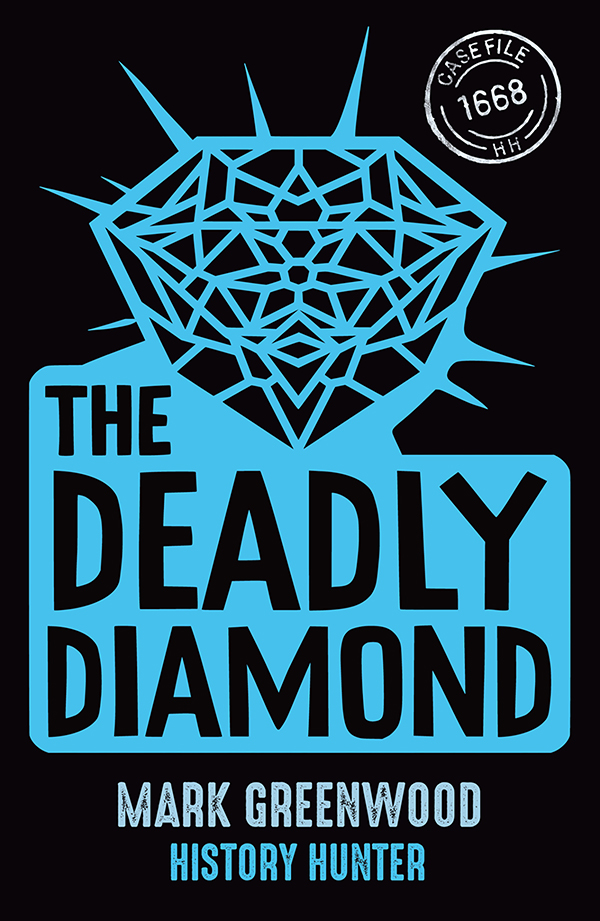
The Deadly Diamond by Mark Greenwood


"To this day the deadly diamond retains a spooky reputation as a stone with an ominous sparkle and the power to bring tragedy to anyone who touches it. But does its ownership bring death, dishonour, disgrace or financial ruin? Can the curse of the most famous jewel in the world be reconciled with reality when many of its owners have lived long and generally prosperous lives?"


Our story of this famous diamond - variously named the Blue Diamond, the French Blue, and the Hope Diamond - begins in India at a diamond mine in 1642. We are not told in detail, but it is very clear that conditions at this mine must have been utterly terrible. Mark Greenwood does mention snakes and overseers and the use of children in the mine. No one is exactly sure, but this diamond was part of a temple idol before it was stolen and then passed through the hands of thieves, con men, nobility, an extremely rich socialite, a famous jeweler and finally presented to the Smithsonian Museum of Natural History which is where you can see it today and from that link you can see many of the aspects and short videos of this story that are mentioned by The Deadly Diamond including the regular postal envelope that was used to send it to the museum - an amazing story. Take a look at these images. 

This is a slim book but such a page turner and readers are also supplied with a timeline, glossary and extra reading list so curious minds can explore this topic further. If I was sharing this book with a group of students (Grade 5 or 6) I think I would begin by showing the tiny diamond in a ring I wear every day using this as a way to talk about diamonds and their value and origins. You could share this ABC television series "Stuff the British stole" with a High school group. There is an episode about a diamond from South Africa and also one about the Koh I Noor diamond. Both are rated PG. I highly recommend The Deadly Diamond as a perfect addition to your school library or pop this title on your Christmas present list - it would be an especially great gift for a boy aged 10+. This book has big print and white pages and a few actual photographs/portraits of the famous people who were involved or who owned this diamond. 

Further reading:

Many of my reviewing colleagues receive advance copies of new Australian titles but up until this week I only received books from one Australian publisher. Now I can add two more to that list including the publisher of this book - Fremantle Press. I recently talked about their new verse novel Trapped by Julia Lawrinson.

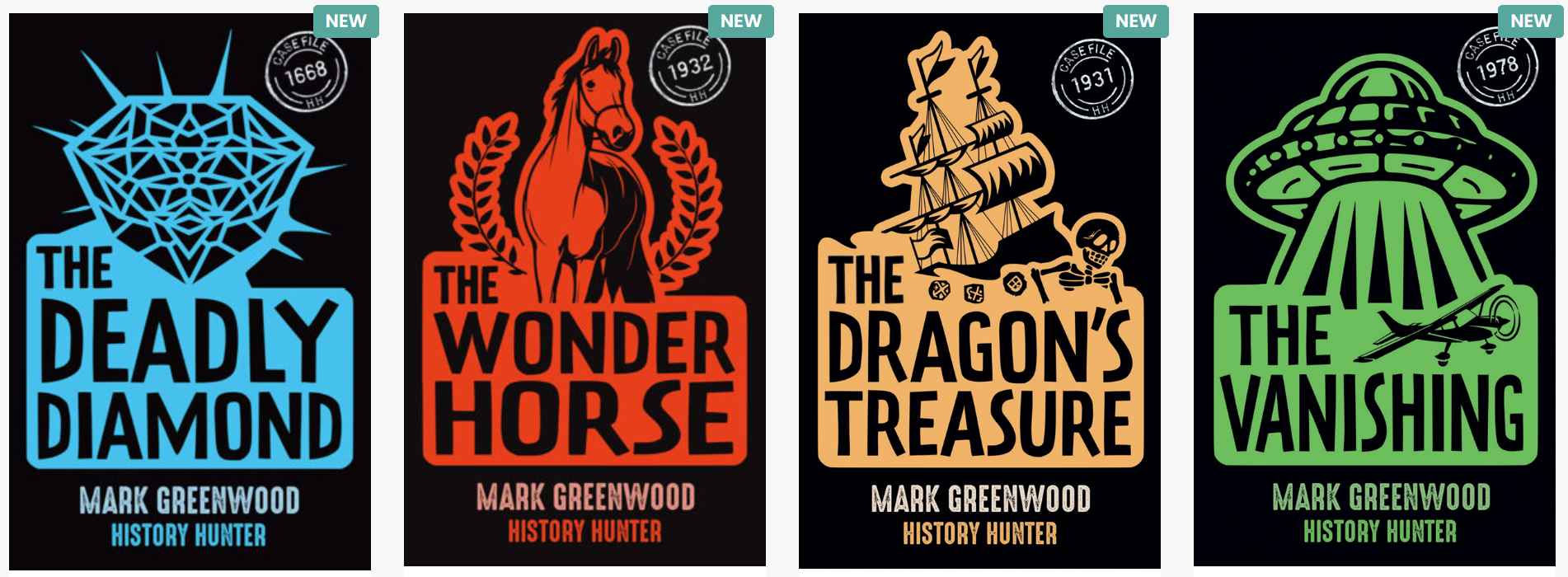
Mark Greenwood has done an enormous amount of research for this book The Deadly Diamond. I simply gobbled up the whole book in one sitting - readers aged 10+ are going to love this book and I am sure the rest of the series are fabulous too. I have another one - The Wooden Horse - ready to read next. Here is the full series called History Hunter:

On the publisher page you can read an extract from The Deadly Diamond and find very detailed and useful teachers notes. There is one word missing from the glossary which your students may need to check - loupe.

I was so interested to read all the ways this stone was cut and changed and reduced in size. I also had no idea about the colours of diamonds - white, yellow, red, dark grey, orange, red, apple green, pink and most desirable of all, the blue.

"The diamonds that came from the fabled mines of Golconda were highly valued. Local rulers jealously guarded the source and kept the largest diamonds for themselves. The radiance of these diamonds was legendary. Many believed they contained a supernatural force. Prized for colour, clarity, size and beauty some were as pure as a drop of dew."

Try to find these two books as companion reads:


This is not about diamonds, but it has the same narrative nonfiction style 
and the same assortment of 'shady' characters.  Highly recommended. 

This form of narrative non fiction is not new but I have not seen any other books in this form for many years. In my previous school library I had other books like this on a range of topics but they are all now long out of print. One series were called True stories published by Allen and Unwin: Stoked! Real Life, Real Surf; Bog Bodies: Mummies and Curious Corpses; Wrecked: Mysteries and Disasters at Sea; Kimberley Warrior: The Story Of Jandamarra; and Soccer: Great Moments, Great Players in World Football. And we also had the It's True series.


Your students who enjoy books that use this form of narrative to tell a true story might find the "I Survived" series in a school or local library. I also had a series called Mega Bites published by Dorling Kindersley in my previous school. 


Wednesday, April 17, 2024

The Last Mapmaker by Christina Soontornvat


Exploits on the high seas and complex characters combine in a tale full of both excitement and heart. An engrossing adventure with the feeling of a whole world to be explored. Kirkus Star Review

Sai (full name Sodsai Arawan) is a girl living in a highly stratified society. She is on the bottom rung. Her father is a petty criminal and they live in squalid conditions. Sai, though, has worked hard and found herself a good job with the esteemed map maker. She has managed to find some clothes suitable for an apprentice and each day she travels into the city to work with Paiyoon. She has a firm goal to better herself and to do this she needs the all important status symbol of a lineal or chain. The more of these a citizen displays the higher their social standing. Sai is twelve. Lineals are given to children when they turn thirteen. They show your heritage.

The Kingdom of Mangkon is huge but the Queen wants more. She sets a challenge to the navy to sail to all corners of the globe to claim new lands in her name. 

Of course, these ships will need a map maker and Paiyoon is famous, but he is old now and unwell and his hands keep shaking. He does secure a place on a ship, but he will need Sai to travel with him to assist with the map making. Sai is very skilled with copying documents and maps. She is thrilled she can go on the voyage. Partly because this is a way to get away from her father and partly because there is a reward at the end of the voyage, and this will mean she can obtain a lineal and a better future.

On board the ship there is the crew of course, and one of them is very suspicious of Sai, but there is also the Captain who is the Queen's great niece, Mr Lark a naturalist, Dr Pinching the ship surgeon, Miss Rian Prasomsap - a former soldier, and Bo a stowaway with an interesting back story. The real dilemma for you as a reader comes when you try to work out who to trust. I was suspicious but also very wrong with my predictions. 

The voyage is long and filled with danger but the really interesting part of this book comes when we discover why the Queen wants to know about these distant lands and what she might do there. She has already almost destroyed some of the places they visit on the voyage and that is why I have added the label colonization to this post. 

"I had expected Falhin to be a green vibrant place like Pitaya Island but it couldn't have been more different. From what I could see, Fahlin was made of mud. The streets near the habour were slick and greasy, and the water was stained brown." Keep reading pages 180-181 to hear what Paiyoon thinks about the Queen and her desire to claim new territory.

Horn Book expand this idea: Class structure, imperial greed, and environmental ravages underpin the narrative arc of this fantastical adventure story, resonating with our own contemporary issues. At the same time, Soontornvat’s Thai-inspired culture and geography provide a vivid backdrop. With emphasis on an intricate plot and quick, accessible prose, Soontornvat provides plenty of excitement while bringing questions of expansionism and de-colonization to young readers.

Publisher blurb: As assistant to Mangkon’s most celebrated mapmaker, twelve-year-old Sai plays the part of a well-bred young lady with a glittering future. In reality, her father is a conman—and in a kingdom where the status of one’s ancestors dictates their social position, the truth could ruin her. Sai seizes the chance to join an expedition to chart the southern seas, but she isn’t the only one aboard with secrets. When Sai learns that the ship might be heading for the fabled Sunderlands—a land of dragons, dangers, and riches beyond imagining—she must weigh the cost of her dreams. Vivid, suspenseful, and thought-provoking, this tale of identity and integrity is as beautiful and intricate as the maps of old.

Watch the trailer from Candlewick. 

Reading it, it doesn’t feel like any other book out there. It grips you from the first page. You believe in these characters, in their wants and dreams and fears. You never doubt for a second their motivations, even when they surprise you with their choices. This may even be the kind of book that kids that usually eschew fantasy would actually like quite a lot. Though fantastical elements exist, there’s a strange reality to them. Consider this the kind of book that kids and their adult gatekeepers will love equally. In other words? Rare rare treasure. Betsy Bird SLJ

I have had this book on my list for a while. It was published in 2023. I saw the hardcover on sale in a bookstore but hesitated to buy it which was silly but anyway I now own the paperback.

Awards for The Last Mapmaker:

  • 2023 Newbery Honor Book
  • New York Times Best Children’s Book of the Year 
  • New York Public Library Best Book of the Year
  • Kirkus Best Book of the Year
  • Walter Dean Myers Honor Book for Young Readers
  • Texas Bluebonnet Master List Selection 
  • A Junior Library Guild Selection 
  • A Common Sense Media Selection 
  • Audiofile Best Audiobook of the Year
  • Chicago Public Library Best Book of the Year
  • YALSA Best Fiction for Young Adults
  • ALSC Notable Children’s Book 2023

I previously talked about this book (five stars) by Christina Soontornvat.


Companion books:


Wednesday, August 24, 2022

All Four Quarters of the Moon by Shirley Marr


Peijing and her little sister Biju have moved to Australia with their parents Ma Ma, Ba Ba and her grandmother Ah Ma. Everyone in the family has to make huge adjustments in order to cope with this new place. Peijing loves her Ah Ma but Ah Ma is beginning to act strangely as her memory deteriorates. None of the adults seem able to talk to Peijing about this. Back in Singapore Ma Ma was popular and confident but with little or no English here in Australia she has retreated into her home. It is so difficult to mesh traditional family customs and expectations with the new life Peijing is experiencing at her school. And also she has new levels of responsibility towards her sister and her mother. 

Peijing and Biju share a Little World. It is all made from paper and they love to add new creatures and invent stories as they play.

"Little World was something familiar. Something safe. Something to escape into. Where minutes could become hours and hours grow into days. Where in the blink of an eye, ecosystems could grow and flourish and collapse again back into the ocean, and large herds of beasts that only existed in your mind could cross from one continent to another. Where something you made yourself could be your home, even just for a while."

"There were zoos and farms and a network of underground burrows and branches of trees made of many pieces of paper sticky-taped together. There were oceans, rivers and lakes too but some of them were so big they stretched from one side of the room to the other."

In a moment that lingers with me, on the day the family leave for Australia, everything in their Little World box is gone. Peijing knows that her mother has done this. Biuj is distraught but the girls find one paper rabbit hidden under a flap in the box. Peijing tells Biuj to hide the rabbit so they can take him to Australia. There is such a raw honesty to this scene that it must be a memory from Shirley Marr's own childhood. In fact I wonder how much of this story is autobiographical such as the scene where Biju refuses to use chopsticks (chapter 10). I also adored the unfold friendship between Peijing and Joanna. Every story needs a special and kind friend like Joanna. 

"Peijing's heart was beating fast. She wanted to yell at the boy to take back what he said about Joanna. She wanted to punch him in the face for saying what he did about her. Then she wanted to run out of the school gates, run until she reached the ocean and, even though she could now swim, make it impossibly back home."

Interspersed between chapters are Biju’s own retellings of myths and fables, offering the sisters a chance to consider elements of Chinese culture as Peijing seeks to navigate between the values of her family and their teachings and what she learns in Australia. And we also witness a transformation of each family member - Ba Ba softens, cooks and forms a relationship with his daughters and Ma Ma finds a job at the Asian Mart. 

This is a read with tons of heart. Peijing, is a kind and family orientated girl, who tries her best to keep a positive outlook but often feels like she's sinking, instead. She struggles not only with the new environment and language but can't seem to find her place in school. Still, she does her best and keeps an inspiring and heart-warming attitude...even when it proves difficult, at times. Especially her relationship with her younger sister touches the heart (even when things aren't always smooth) and makes this a wonderful read about the sisterly bond. Book Worm for Kids

There are so many things to say about this book – it’s lyrical, magical, beautiful, and comforting – because it reassures all readers that we are not alone in feeling like we don’t fit in, and lets readers know that we can find a way to fit in and be ourselves. The Book Muse

As I write this it is Book Week here in Australia and one of the major things that happens this week is the announcement of our National children's book award winners by the Children's Book Council of Australia.  There are six categories of awards and one of these is for Younger Readers (in the US you might call this elementary school).  The winner for 2022 is by Shirley Marr - A Glasshouse of Stars.  


When you read both of these book I recommend you should then try to find books by Gabrielle Wang and Grace Lin (especially Where the Mountain meets the Moon). 

Saturday, July 24, 2021

Running out of Night by Sharon Lovejoy


Publisher blurb: Every day is a misery for a nameless, motherless Southern girl who is treated cruelly by her pa and brothers. Her life changes forever when a runaway slave named Zenobia turns to her for help and shelter. Longing for her own freedom, the girl decides to run away, and she and Zenobia set off on a harrowing journey. Along the way, Zenobia names the girl Lark, after the bird, for her ability to mimic its song.  Running by night, hiding by day, the girls are pursued by Lark’s pa and brothers and by ruthless slave catchers. Brightwell, another runaway slave, joins them, and the three follow secret signs to a stop on the Underground Railroad. When the hideout is raided and Zenobia and Brightwell are captured, Lark sets out alone to rescue her friends.

Cliffhanger endings for nearly every chapter prove that adventure tropes can work just as well in historical fiction to keep the pages turning, and a happy but bittersweet conclusion ensures that both girls finally find safety. Bulletin of the Centre for Children's Books

I read this book as an ebook. It was first published in 2014 and here in Australia the paperback is nearly $25 which seems terrible to me considering this is a book with just 300 pages. I much prefer print books but the advantage of an ebook is I can highlight pieces of text to quote here which will give you a flavour of this powerful writing:

"I don't have no name. My mama died just when I were borned and nobody bothered to give me one, ceptin Grandpa, who always called me Sweet Girl when we were alone."

"I squared my chin and bit down on my tongue to keep it from waggin me into trouble again."

"I learnt a long time ago that turnin into a shadow, disappearin into whatever was round me were sometimes the only way to stay alive."

"I belonged to him, like his hunting dogs and his guns. He wouldn't never give up looking for me around here."

"Grandpa always told me that bad beginnings are a sign of a good endin. I hoped I didn't have to wait too long for a the good to come."

"And why did I have to take a beatin for someone I didn't even know, or care about? Someone who probably wouldn't give me a butter bean if I were the hungry one. Why should I risk my own hide for her?"

"Not bad enough that I'm a mite smaller than most girls, and that my ugly red hair stands out like broom corn, but now look what I were stuck with - a tall, raggedy runaway slave girl who dragged trouble behind her like a tail. We'd stick out worse n'chickens in Sunday dresses."

"What were that bird you were singin to?' 'That were a lark,' I answered. 'I be thinking on that and now I namin you Lark, ... that a name you can keep. You (are) Lark."

"I looked down. Me and Zenobia set next to each other, our arms wrapped around out legs. Her arms was the colour of dark clover honey, mine pale, white, and freckled like a wood thrush's chest. I had forgot that we was different colours."

There are some rich words in this book and I enjoyed the authentic Southern voice. I learnt these new words: scuppernong (grape); crawdad (crayfish); fetters (metal ankle chains); pinders (peanuts); buckeye (a seed); and milk name (first name given to a baby).

Here in Australia we have a weekly newspaper column penned by the radio journalist and presenter Richard Glover.  I love these quotes from his recent writings:

Saturday 24th July, 2021 "Books are best read in one or two sittings. In the before times, I could take a couple of weeks to read a book ... The plot would lose it momentum. ... A good author deserves a few hours of continuous reading."

I'm glad I read Running out of Night over two or three long and very absorbing sessions. 

Saturday 30th April, 2021 "Every book is a meeting of minds. ... Reading is an intense experience. ... The reader, after all, is the one who brings the text to life. A text without a reader, is a score without a piano. And then there’s the variation in pianos – some are out of tune, unable to even attempt the high notes; others have the ability to bring the score to tuneful life. ... Certainly, reading is not a passive activity. If the book is good, it should be transformative, leaving you slightly altered. Maybe even improved." SMH

I would add to this some wisdom (not as well expressed) about the way, as a reader, you put yourself into the hands of an author - trusting they will keep you (and their characters who may now be your friends) safe. I felt this way right through Running out of Night. So many utterly dreadful, violent, frightening, and truly terrible things happen to Lark and her new friends but I just kept hold of Sharon Lovejoy's hand, confident in the knowledge she would keep me, and those precious children, safe. 

In the author notes I discovered Sharon Lovejoy once owned a herb shop. In this book Lark uses herbs with great care and wisdom. Sharon has added her own passion to the story in a beautiful way. I recommend Running out of Night for mature readers aged 11+. 

This book reminded me of these:


I am now also keen to read Elijah of Buxton by Christopher Paul Curtis. Reviews also mention Trouble don't last by Shelley Pearsall and Stealing Freedom by Elisa Carbone. 

Friday, March 12, 2021

Girl of the Southern Sea by Michelle Kadarusman


"All you see is a poor girl ... A girl without power of choices. But you are wrong. 

I am here to live a different story. I am here to write my own story."


Nia has lost her mother and her father has begun drinking heavily to ease his grief. Nia, young brother Rudi and her father live in poverty. Each week it is a desperate struggle to find enough money for their rent payment and food. Nia's father has a small food cart from which he makes fried bananas to sell near the busy railway station. 

Nia is a clever girl. She longs to continue her education and move onto High School but this costs money and now that her father has stopped earning money due to an accident she has to leave school and attend to the food cart. 

Nia loves to tell stories and these are woven into this book. Her stories are about Dewi Kadita, Princess of the Southern Sea and are based on Javanese folktales.

Her life takes a strange turn when Nia is involved in a mini bus accident. While others are badly hurt and one boy is killed, Nia walks away uninjured. A witness to this incident - Mr Oskar a local tailor - declares Nia is now a special girl and that buying her fried bananas will bring good luck. Long queues form as people jostle to buy from her stall. Some what unwisely Nia increases her price and money begins to flow in but it is very clear this enterprise is doomed. Meanwhile her father has disappeared and Nia and her brother are struggling. Oskar, who keeps hanging around, also has his own, shocking reasons, for wanting to befriend Nia. 

It is a sharp and politically attuned work that will give readers further appreciation for the value of access to education, health care, and justice. Quill and Quire

A thought-provoking peek into a culture ... Kirkus

Here is an alternate cover. Which do you like best?


I have had such a feast of wonderful reading this week - Talking to Alaska by Anna Wolta (due out in July); Tiger Daughter by Rebecca Lim; Beyond Belief by Dee White; and Haywire by Claire Saxby and now I add Girl of the Southern Sea to this list.

I do need to give a violence warning for The Girl of the Southern Sea. The publisher lists this book as suitable for ages 9-13. Once again, as I often seem to do lately, I disagree. In my view this is a book for mature readers aged 11+. There is a horrific scene in this book when the crowd discover Nia is not "a lucky charm" as they had been led to believe. The mob hurl stones at her and then she is doused in kerosene. Nia survives but the horror and raw hatred of this scene lingers with me (an adult reader) many days later. 

Michelle Kadarusman lives in Canada but she was born in Melbourne. She is the author of The Theory of Hummingbirds.


Companion reads: